
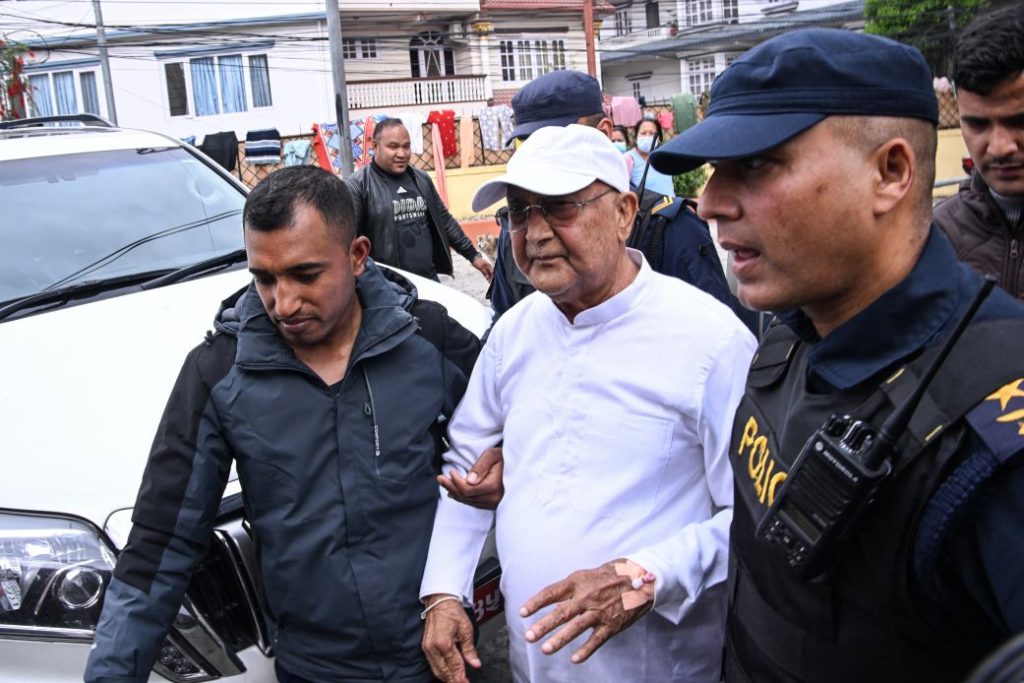
He was arrested on the morning of March 28, 2026, at his residence.
Following his arrest, he was taken to a hospital in the capital, Kathmandu, for a medical examination, as required by law for all detainees in the country.
The hospital stated that results from his medical tests are still pending, noting that the 74-year-old has previously undergone two kidney transplants.
His arrest came a day after the swearing-in ceremony of the new Prime Minister, Balendra Shah, a former popular rapper known as Balen.
Oli was detained after a commission set up to investigate last year’s protests added him to the list of individuals under investigation, alongside former Home Affairs Minister Ramesh Lekhak. The commission recommended legal action against them for alleged failure to properly fulfill their duties.
Kathmandu Police spokesperson Om Adhikari said the arrests were carried out in accordance with the law and that investigations will continue, although specific charges related to the protests have not yet been disclosed.
Oli has denied the allegations, describing them as politically motivated and an attempt to discredit him.
His lawyers argue that his detention is unjustified, stating there is no evidence he would flee justice or refuse to cooperate with investigators.
Following his arrest, supporters of his party, the Communist Party of Nepal (Unified Marxist–Leninist), staged protests in Kathmandu demanding his release. Party leaders have also warned of possible nationwide demonstrations.
Meanwhile, the new Home Affairs Minister, Sudan Gurung, welcomed the arrests, calling them a step toward justice.
“No one is above the law. This is not revenge, but the beginning of a pursuit for justice,” he said.
Families of around 70 people who died during the protests have for months been demanding accountability from those responsible.
The unrest began in September 2025, when youth across Nepal took to the streets protesting poor governance. The protests eventually forced Oli to resign as Prime Minister, with demonstrators calling for Sushila Karki to serve as interim Prime Minister, a proposal that was implemented.
The protests, largely driven by Generation Z, turned deadly, with many demonstrators reportedly shot by police while opposing a government decision to shut down social media platforms in an attempt to disrupt their coordination.
At 35, Prime Minister Balendra Shah, who previously served as Mayor of Kathmandu gained widespread support during the protests by engaging with youth through social media, a factor that contributed to his rise to power.


