
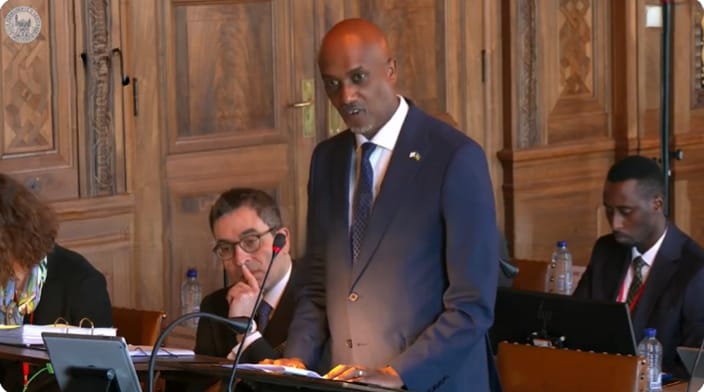

According to a summary released by the court, hearings were conducted from March 18 to 20, 2026, during which both parties presented their arguments. The tribunal is currently reviewing submissions from both sides before reaching a final decision.
Background of the case
Rwanda filed its case on November 24, 2025, while the United Kingdom submitted its response on December 12, 2025. Proceedings officially began in early January 2026, followed by written submissions and rebuttals throughout January and March.
The case stems from the UK’s decision to terminate a migration partnership agreement that aimed to relocate asylum seekers to Rwanda. Rwanda argues that this decision was made unilaterally, without proper consultation, and in violation of agreed legal procedures.
Rwanda’s position
Rwanda’s legal team, led by Justice Minister Emmanuel Ugirashebuja, emphasized the country’s long-standing commitment to hosting refugees and migrants, citing its experience and humanitarian policies.
Rwanda maintains that the UK failed to honor financial obligations outlined in the agreement. Specifically, it points to two payments of £50 million each, expected in April 2025 and April 2026 under the Economic Transformation and Integration Fund (ETIF), which were not delivered.
In addition to financial compensation, Rwanda is also seeking a formal apology from the UK for what it describes as a deliberate breach of contractual obligations.
UK’s defense
The United Kingdom, under Prime Minister Keir Starmer, argues that after the July 2024 general elections, the new government decided to discontinue the migration scheme in line with its manifesto commitments.
The UK acknowledges the original financial commitments but claims that subsequent discussions in November 2024 led to a legally binding revision of the agreement. According to its argument, Rwanda agreed to waive the ETIF payments, meaning no outstanding financial obligations remain.
What Rwanda seeks
Beyond compensation, Rwanda says the case is about upholding the integrity of international agreements. It argues that political changes in partner countries should not override legally binding commitments.
Kigali hopes the outcome will set a precedent reinforcing respect for international agreements in global partnerships.
Next steps
Once the ruling is issued, both parties will have 10 days to review the decision and request corrections for any clerical errors, with final adjustments to be completed within 30 days.