
A statement released by the U.S. Bureau of African Affairs within the Department of State reads: “During this period of remembrance, we honor the victims of the Genocide against the Tutsi and reflect on the unimaginable atrocities committed. The United States stands with Rwanda in unity and reconciliation and strongly condemns genocide denial and distortion.”
In another statement, the Acting Assistant Secretary of State for African Affairs, Nick Checker, said the U.S. remembers over one million Tutsi, as well as Hutu, Twa, and others who were killed for opposing the genocidal government.
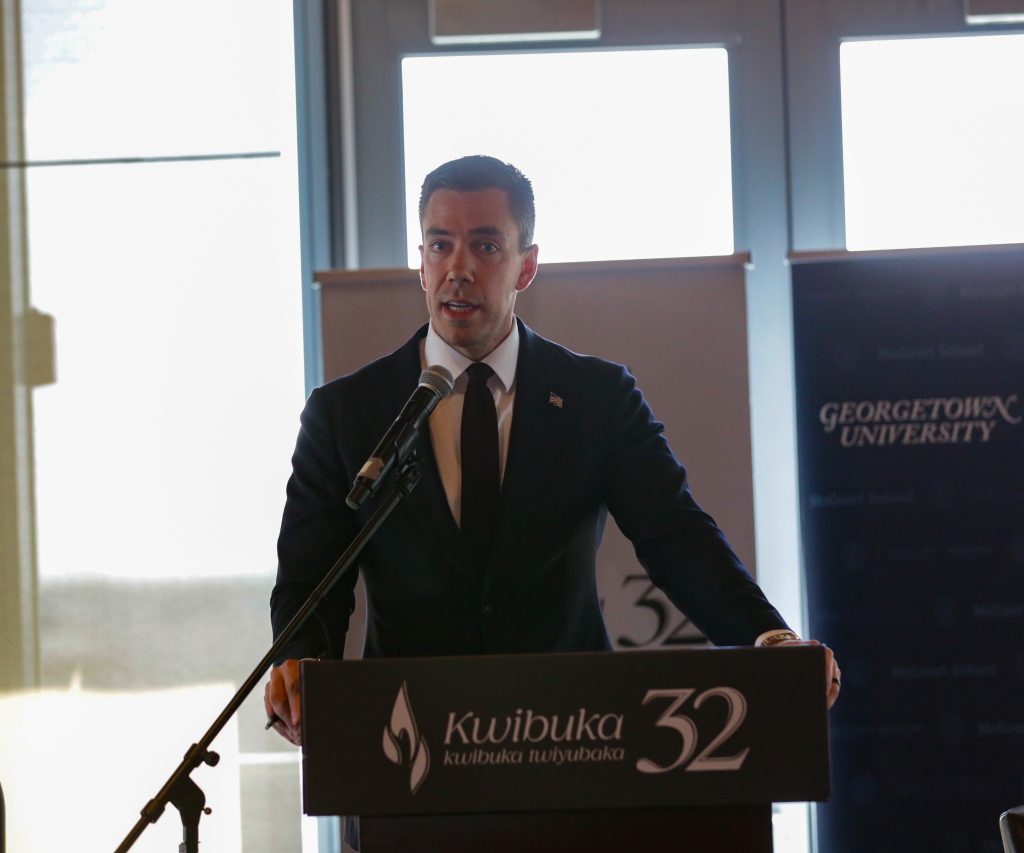
Checker expressed solidarity with survivors, families who lost loved ones, and communities that were devastated.
“I personally visited Rwanda and saw firsthand the sites where the genocide occurred, in Nyamata and Ntarama, former churches where thousands of Tutsi were brutally killed by extremists,” he said.
He added that standing before the altars in those churches deeply affected him.
“At the altar, where the Holy Mass is celebrated and the blood of Jesus symbolizes salvation, the blood of innocent victims of the Genocide against the Tutsi was shed.”
He noted that seeing altars turned into places of mass, highlights the contrast between Jesus Christ’s message and humanity’s capacity for cruelty.
He emphasized that the genocide did not happen by accident but was the result of deliberate actions by the leadership at the time.
“The United States supports Rwanda’s efforts toward unity and reconciliation. We condemn those who spread hate speech and fuel conflict instead of promoting peace.”
The U.S. also stated that this period of remembrance is a time to reaffirm its commitment to preventing such atrocities in the future. It stressed that justice for survivors through prosecuting perpetrators, is essential.
The United States highlighted its role in supporting Rwanda, including advocating for accountability for genocide perpetrators.
It also noted its contribution to the establishment of the International Criminal Tribunal for Rwanda (ICTR).
“Through diplomatic cooperation and information sharing, we have helped arrest, prosecute, and extradite genocide suspects. The United States will continue working with partners to bring perpetrators to justice.”
During the launch of the 30th commemoration of the Genocide against the Tutsi, President Paul Kagame addressed those who have resisted using the correct terminology.
“In 2018, the United Nations General Assembly adopted a resolution recognizing the correct name ‘Genocide against the Tutsi,’ supported by all member states except one,” he said.
Previously, the United States referred to the genocide simply as “genocide” or “the Rwandan genocide,” without specifying the targeted group.
Many U.S. statements also referred broadly to remembering “Tutsi, Hutu, Twa, and others” killed, which does not reflect the historical reality.
In 1994, Tutsi were specifically targeted, and 93.7% of the victims were Tutsi during the 100 days. The remaining victims were others killed for opposing the genocidal ideology, according to Rwanda’s 2004 national census, which recorded 1,074,071 victims.
On January 23, 2018, the United Nations General Assembly officially designated April 7 as the International Day of Reflection on the Genocide against the Tutsi, replacing the earlier name “International Day of Reflection on the 1994 Genocide in Rwanda.”
Rwanda advocated for this change to reflect historical truth and counter genocide denial and distortion.
At the time, the United States and some European countries opposed the resolution, arguing that the new terminology did not fully capture crimes committed against other groups.
Former U.S. Secretary of State Antony Blinken, when visiting Kigali in 2022, stated: “Our position on acknowledging the genocide and the atrocities is well known […] We will continue working within the UN to arrive at appropriate historical terminology while ensuring such events never happen again.”
Former U.S. Ambassador to the UN, Kelly Craft, also expressed dissatisfaction with how the resolution process was conducted, arguing that focusing solely on “Genocide against the Tutsi” overlooked the suffering of other groups.
However, critics pointed out that the United States does not apply this reasoning to other genocides, such as the Holocaust.
During World War II, about six million Jews were killed in the Holocaust, out of approximately 75 million total deaths. Although others were also killed such as Roma, disabled individuals, political opponents, and others, they are not classified as victims of the Jewish genocide, because the Holocaust specifically refers to the systematic extermination of Jews by the Nazis.
This comparison has led many to question why the United States long avoided using accurate terminology when referring to the Genocide against the Tutsi in Rwanda.