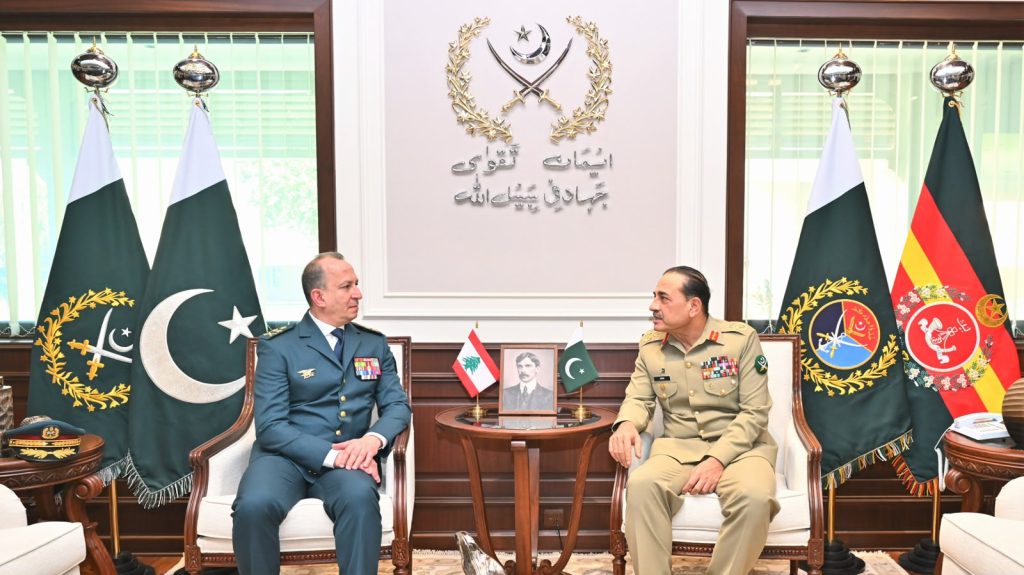

Lebanese Armed Forces Commander-in-Chief General Rodolphe Haykal met with Pakistan’s Chief of Army Staff and Chief of Defense Forces, Field Marshal Syed Asim Munir, at the General Headquarters (GHQ), where the two sides reviewed regional security developments and explored ways to enhance defense collaboration.
According to Pakistan’s military media wing, Inter-Services Public Relations (ISPR), the discussions focused on “matters of mutual interest, the evolving regional security environment, defense cooperation and prospects for enhancing bilateral military relations.”
The talks also covered expanded professional exchanges, military training programmes and stronger institutional links between the armed forces of both nations.
Field Marshal Munir reaffirmed Pakistan’s commitment to its longstanding relationship with Lebanon and emphasized Islamabad’s willingness to broaden defence cooperation with the Lebanese Armed Forces.
General Haykal praised the professionalism of Pakistan’s military and acknowledged its contributions to regional stability and international peacekeeping missions, according to the ISPR statement.
The visit comes at a sensitive moment for the Middle East, where diplomatic efforts to end months of conflict involving Iran, Israel and regional allies continue to face challenges. Lebanon remains a key focal point in those negotiations due to ongoing tensions between Israel and the Iran-backed Hezbollah movement.
Reports indicate that Pakistan has been actively engaged in diplomatic mediation efforts involving the United States and Iran, with regional security concerns extending to developments in Lebanon.
Haykal’s trip to Pakistan was announced by the Lebanese military over the weekend. Sources familiar with the matter previously indicated that the visit was connected to broader regional discussions aimed at reducing tensions and supporting peace initiatives.
Despite recent ceasefire efforts, clashes and military exchanges in parts of Lebanon have continued, underscoring the fragile security environment facing the region.
The meeting between the two military leaders signals a shared commitment to strengthening defence cooperation while supporting broader efforts to promote stability in an increasingly volatile Middle East.