
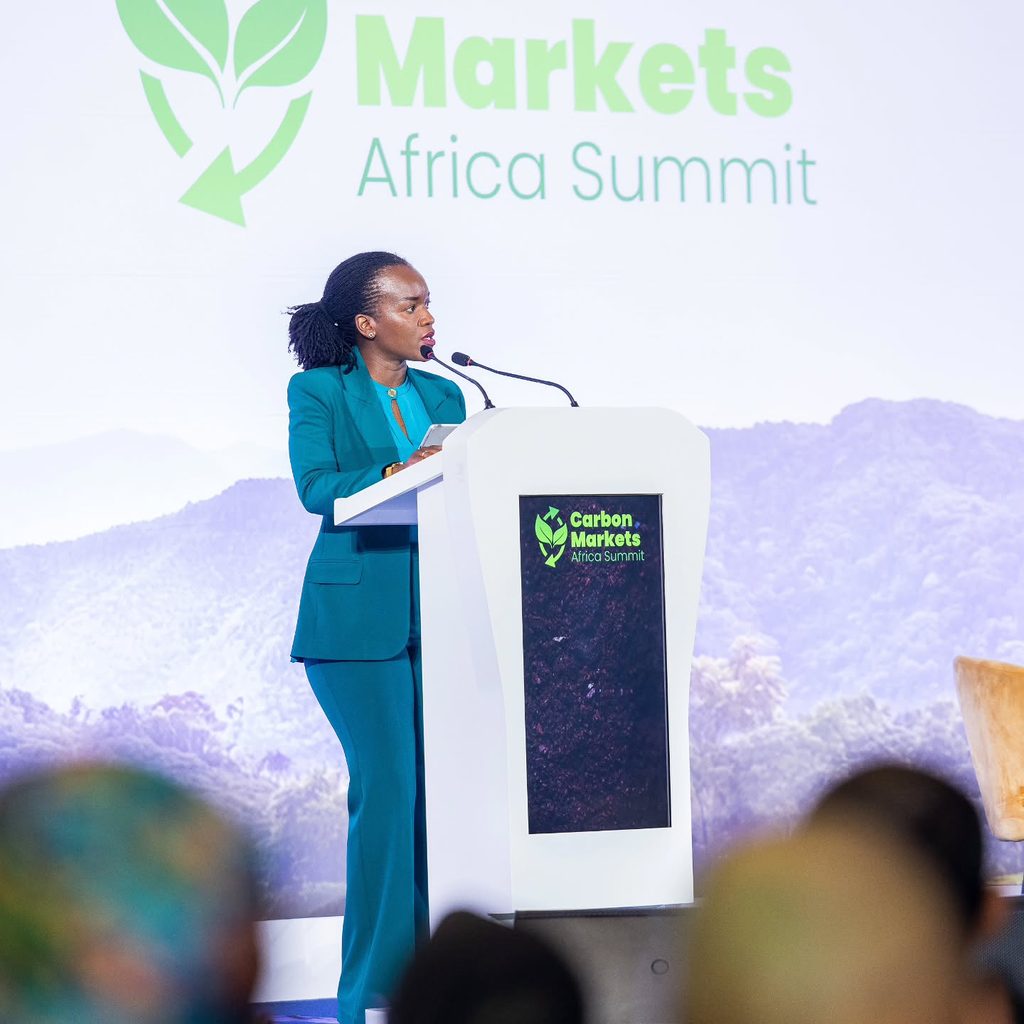

Rwanda’s Minister of Environment, Dr Arakwiye Bernadette, highlighted the potential of Africa-led carbon markets to attract investment, accelerate climate action, and turn the continent’s natural resources into sustainable economic opportunities for local communities.
At the Carbon Markets Africa Summit 2026 in Kigali, Dr Arakwiye highlighted Africa’s growing role in shaping carbon markets and its potential to attract long-term financing for projects that protect the environment and support economic development.
The summit, taking place from 13 to 15 October at the Kigali Convention Centre, brings together governments, financial institutions, project developers and international carbon market stakeholders to strengthen partnerships and advance climate finance across the continent.
“Africa is no longer waiting for opportunity; it is creating it,” she said, expressing confidence in the continent’s ability to develop homegrown solutions and build strong partnerships with international investors.
Africa’s forests, wetlands, fertile soils and renewable energy resources offer opportunities to develop carbon projects that protect the environment, generate income and improve community livelihoods.
Rwanda has so far registered 29 carbon market projects covering forestry, agriculture, land conservation, electric mobility, waste management and renewable energy. Building on this progress, Dr Arakwiye highlighted the potential to diversify carbon market initiatives and attract investment into sectors with significant opportunities to reduce greenhouse gas emissions.
“This is an achievement worth recognizing. But it also tells us something important, that our markets remain too concentrated in interventions that are easier to measure, easier to finance, and easier to sell. And we must now broaden that frontier,” she said.
Dr Arakwiye encouraged greater investment in renewable energy, electric mobility, sustainable waste management, agriculture and nature-based solutions. These sectors offer opportunities to expand carbon markets while supporting livelihoods across Africa.
She also underscored the importance of strengthening technical expertise, preparing investment-ready projects and expanding access to early-stage financing.
Rwanda is exploring ways to channel part of the proceeds from carbon transactions through the Rwanda Green Fund to support project preparation and refinancing, helping initiatives access the resources needed to advance their development.
The minister highlighted transparency, credible verification and fair benefit-sharing as essential foundations for building trusted and successful carbon markets. She emphasised that communities whose land and natural resources contribute to carbon projects should share in the financial benefits they generate.
“Because benefits cannot be fairly shared from revenues that cannot be seen. When we do this, transparency stops being a cost. It becomes a competitive advantage,” she said.
Dr Arakwiye also encouraged international partners to invest in Africa’s long-term capacity to develop and manage its carbon markets by supporting institutions, data systems, technical skills and investment pipelines.
“To our international partners, do not ask Africa to simply supply credits. Partner with Africa to build institutions, data systems, technical skills, and investment pipelines,” she said.
The summit highlights Africa’s ambition to strengthen its position in global carbon markets and translate climate leadership into economic opportunities. By building on existing achievements, attracting investment across key sectors and strengthening international partnerships, African countries can mobilise climate finance, support local communities and make greater use of their natural resources in the transition towards a sustainable, low-carbon economy.