
Arab Gulf countries have stepped up quiet but intensive diplomacy in an effort to prevent a military confrontation between the United States and Iran, fearing that any strike on Tehran—or a sudden collapse of the Islamic Republic—would plunge the region into a new cycle of instability with far-reaching consequences.
The push comes amid heightened tensions following renewed threats by U.S. President Donald Trump, who has warned of possible military action against Iran as the country faces widespread protests and violent clashes. While Washington has not spelled out its next move, the rhetoric has unsettled capitals across the Gulf, where leaders worry that escalation could disrupt energy markets, endanger foreign investment, and expose their territories to retaliation.
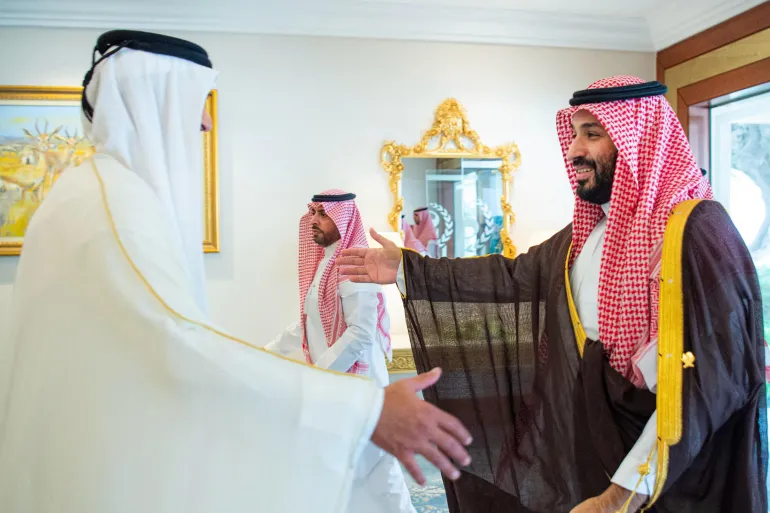
According to regional analysts, Saudi Arabia, Qatar, and Oman have been particularly active behind the scenes. Riyadh is reported to have urged Washington to exercise restraint, while Doha and Muscat have focused on keeping diplomatic channels open between American and Iranian officials. Their efforts intensified after reports suggested that direct communication between the two sides had stalled, raising fears that miscalculation could trigger an abrupt military showdown.
“All the Gulf states were alarmed by the breakdown of traditional communication channels,” said Anna Jacobs Khalaf, a Gulf analyst and non-resident fellow at the Arab Gulf States Institute. “They were uncertain about U.S. intentions and deeply concerned about where a confrontation could lead.”
The anxiety is rooted in both recent history and hard security realities. Iran retains significant missile capabilities and maintains allied armed groups across the region. A senior Iranian official recently warned that U.S. bases in countries such as Saudi Arabia, the United Arab Emirates and Türkiye could become targets if Iran is attacked. Shortly after, some personnel were reportedly withdrawn from Qatar’s Al Udeid airbase, the largest U.S. military facility in the Middle East.
For Gulf governments, the spectre of retaliation is not theoretical. In 2019, attacks on Saudi oil facilities, claimed by Iran-aligned forces, temporarily cut global energy supplies. More recently, Iran launched missiles at the Al Udeid base following U.S. strikes on its nuclear infrastructure, setting a precedent for direct confrontation on Gulf soil.
Beyond immediate security risks, there is a deeper fear of strategic chaos. The 2003 U.S. invasion of Iraq and the turmoil that followed—civil war, extremist insurgencies, and the rise of the so-called Islamic State—remain a cautionary tale. Gulf leaders worry that a sudden power vacuum in Iran, a country of more than 90 million people with complex ethnic, political, and military structures, could unleash forces even harder to contain.
“They may want to see Iran’s leadership weakened, but they are far more concerned about uncontrolled collapse and radicalisation,” Khalaf noted. “No one wants a repeat of Iraq on a much larger scale.”
Economic considerations add another layer of urgency. The United Arab Emirates, particularly Dubai, maintains strong trade links with Iran. Qatar shares with Tehran the world’s largest natural gas field, while Oman has long played the role of discreet mediator between Iran and the West. Saudi Arabia, pursuing ambitious economic diversification under Vision 2030, views regional stability as essential to attracting investment and growing tourism.
“Our objective is stability and calm so we can focus on building a better future for our people,” Saudi Minister of State for Foreign Affairs Adel Al-Jubeir said this week, reflecting a broader regional consensus.
While historical rivalries persist—most notably between Riyadh and Tehran—recent years have seen a shift toward pragmatic engagement aimed at managing tensions rather than escalating them. Analysts say Gulf capitals might welcome gradual change in Iran that leads to moderation on nuclear and missile programmes, but strongly oppose abrupt regime change imposed by force.
“A slow, negotiated evolution is one thing,” said Saudi political analyst Khaled Batarfi. “A sudden collapse with the risk of fragmentation and war is another. The region is already burning. No one wants another fire at their doorstep.”
As uncertainty over Washington’s next move continues, Gulf diplomacy is now focused on one central goal: keeping dialogue alive, lowering the temperature, and preventing a crisis that could redraw the security map of the Middle East with unpredictable and potentially devastating consequences.