
Mozambique is facing one of its worst flood emergencies in recent years, with more than half a million people affected across the country’s southern and central regions, the United Nations has said, as relentless rains continue to batter large swathes of southern Africa.
Since mid-December, torrential downpours have triggered widespread flooding in the provinces of Gaza, Maputo, and Sofala, inundating towns, cutting off major transport corridors, and forcing mass evacuations. According to the UN, nearly 5,000 kilometres of roads have been damaged in nine provinces, severely disrupting supply chains and access to essential services.
“The main road connecting the capital, Maputo, to the rest of the country is now inaccessible. Supply lines are significantly disrupted, and authorities report the loss of more than 27,000 heads of livestock,” said Farhan Haq, Deputy Spokesperson for the UN Secretary-General, briefing reporters in New York.
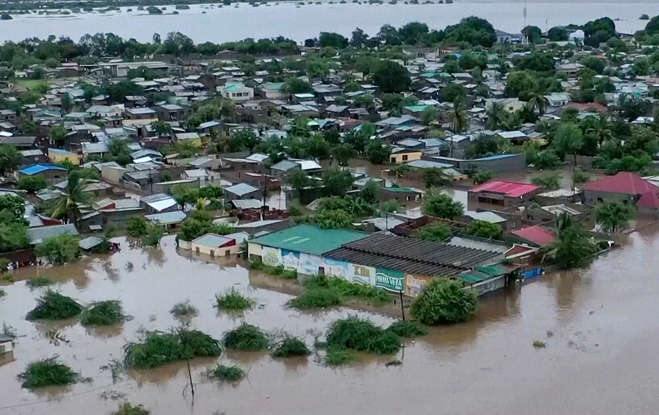
The humanitarian impact is most acute in Gaza Province, where floodwaters from the Limpopo River and its tributaries have submerged vast low-lying areas. Provincial Governor Margarida Mapandzene Chongo said more than 327,000 people have been displaced and are currently sheltering in schools, churches and other temporary centers. Authorities have ordered the evacuation of residents from vulnerable parts of the provincial capital, Xai-Xai, as rising waters threaten to engulf the city.
Videos shared by local authorities show streets transformed into rivers and entire neighborhoods underwater. In nearby Chokwe, floodwaters have nearly swallowed houses, leaving only rooftops visible.
Across the country, at least 50,000 people are now housed in more than 50 temporary accommodation centers, while rescue operations continue. Mozambique’s disaster agency said helicopters have been deployed to reach stranded communities, rescuing more than 100 people in a single day, including children, elderly residents and a pregnant woman in labor who had been trapped on higher ground.
The floods have also taken a heavy toll on critical infrastructure. Health facilities and schools have been damaged, 152 kilometres of roads completely destroyed, and more than 3,000 kilometres partially washed away, according to the Ministry of Transport and Logistics. Officials estimate that around 40 percent of Gaza Province is currently submerged.
With rivers swollen by heavy rains not only in Mozambique but also in neighboring South Africa and Zimbabwe, authorities warn that the situation could deteriorate further. “The situation is likely to worsen,” Governor Chongo said, noting that floodwaters from upstream catchments are still flowing toward southern Mozambique.
The disaster has prompted President Daniel Chapo to cancel his planned attendance at the World Economic Forum in Davos, underscoring the gravity of the crisis at home.
The UN and humanitarian partners have appealed for urgent funding to sustain relief operations, as food supplies, clean water, shelter and medical services are stretched thin. The floods are part of a broader pattern of extreme weather affecting the region, with South Africa, Zimbabwe, Malawi, Zambia, Tanzania, Botswana, Lesotho and Eswatini also reporting severe flooding in recent weeks.
For Mozambique, a country already vulnerable to cyclones, droughts and climate shocks, the current emergency is another stark reminder of the growing human and economic costs of extreme weather. Authorities have placed the nation on its highest red alert, warning that recovery could run into hundreds of millions of dollars, even as thousands of families remain displaced and the waters continue to rise.