
At the World Economic Forum in Davos 2026, global leaders laid bare a shifting geopolitical landscape, one in which growing uncertainty around U.S. foreign policy may be quietly reshaping alliances and opening strategic space for China to draw closer to Europe as a trusted economic and political partner.
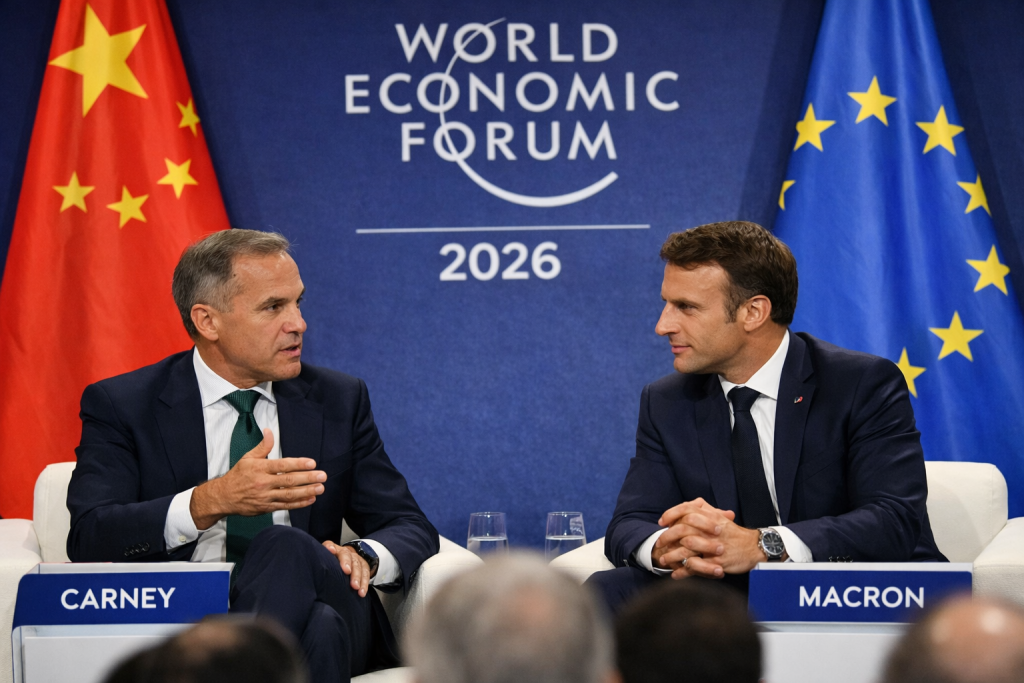
Canadian Prime Minister Mark Carney delivered one of the most consequential speeches of the forum, warning that the rules-based international order is under strain and that middle powers can no longer assume stability will be guaranteed by any single actor.
“If you’re not at the table, you’re on the menu,” Carney said, urging countries to strengthen multilateral cooperation and diversify partnerships in an era of rising geopolitical competition. He stressed that dialogue, predictability and respect for sovereignty must remain the foundation of global relations.
His remarks came as tensions simmer over U.S. ambitions in Greenland and Venezuela. U.S. President Donald Trump has publicly stated that the United States would obtain Greenland “one way or another — peacefully or otherwise,” a comment that has unsettled European capitals and raised concerns about unilateralism in strategic regions.
For many in Europe, the Greenland issue is no longer just about territory; it symbolizes a broader anxiety about coercive diplomacy and the erosion of long-standing norms. It is in this context that leaders are increasingly looking toward alternative poles of stability.
French President Emmanuel Macron, speaking at the same Davos forum, offered a notable signal of Europe’s evolving economic diplomacy. While reaffirming Europe’s commitment to strategic autonomy, he openly invited greater Chinese direct investment, particularly in green technology, advanced manufacturing and innovation.
“More Chinese foreign direct investment can contribute to our growth,” Macron said, adding that cooperation based on mutual respect and clear rules could serve both European competitiveness and global economic stability.
Macron’s message was carefully calibrated: Europe will defend its interests, but it will not close the door to China. Instead, it seeks a partnership that is balanced, transparent and anchored in long-term development goals.
Together, the speeches by Carney and Macron reflected a subtle but important shift. As Washington’s posture on Greenland and Latin America raises questions about predictability, Europe and its partners are recalibrating. In that strategic rebalancing, China is positioning itself as a steady economic actor — one emphasizing trade, investment and multilateralism at a time when geopolitical pressure is intensifying.
In Davos, the contrast was striking. On one side, a narrative of territorial assertion and hard power. On the other, calls for dialogue, investment and cooperative growth. The result may be an unintended consequence of global rivalry: a Europe more open to China, not as a challenger, but as a pragmatic partner in an increasingly fragmented world.