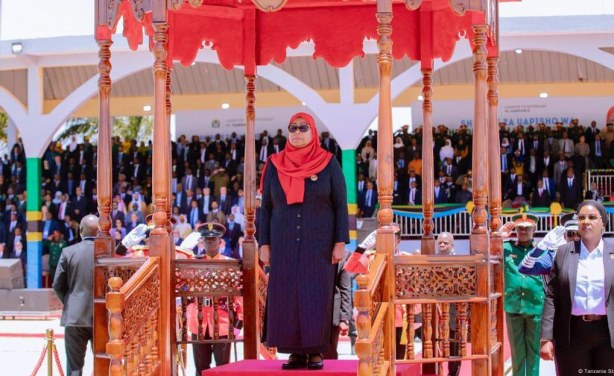

As President Samia Suluhu Hassan approaches her first 100 days in office following Tanzania’s contested 2025 general election, the government says early economic indicators point to progress, particularly in industry, trade, and health. However, political tensions and human rights concerns continue to cloud the broader picture.
The Ministry of Industry and Trade has reported notable gains during the period, citing expansion in industrial zones, increased youth entrepreneurship financing, and growth in business incubation and digital market access. Minister Judith Kapinga said new investments have been recorded across strategic sectors, including clean energy, agriculture, pharmaceuticals, and fertilizer production, areas the government views as critical for long-term economic resilience.
According to the ministry, progress has also been made in value addition, aimed at reducing reliance on raw exports while creating local jobs. Several new factories have reportedly come online, while others remain under development as part of Tanzania’s broader industrialisation agenda.
In the health sector, the government has highlighted plans to launch Universal Health Insurance within the 100-day window, a move officials describe as transformative for access to healthcare. Tanzania has also sought to showcase its health reforms internationally, including participation in the Nordic-Africa Health Conference held in Sweden on 22 January 2026, where officials presented national progress on health systems strengthening.
President Samia’s leadership has also renewed conversations around women’s political representation, with analysts noting that her continued presidency sustains symbolic momentum in a political landscape long dominated by men.
However, these economic and social claims come amid post-election tensions. President Samia was declared the winner of the October 29, 2025 election with 98% of the vote, a result disputed by opposition groups and followed by widespread demonstrations. Subsequent investigations, including a CNN probe, have raised questions about the conduct of security forces during the unrest, with reports of arrests, temporary internet disruptions, and more.
The government has denied wrongdoing, with President Samia ordering investigations into the unrest and blaming “foreign instigators” for the violence. At least 240 people were reportedly charged with treason following the protests, deepening concerns among rights groups.
As Tanzania weighs the impact of President Samia Suluhu Hassan’s first 100 days, the picture remains mixed. While officials point to tangible economic and health-sector initiatives, critics argue that political stability, accountability, and public trust will ultimately determine whether early gains translate into sustainable economic growth.
Source : AllAFrica