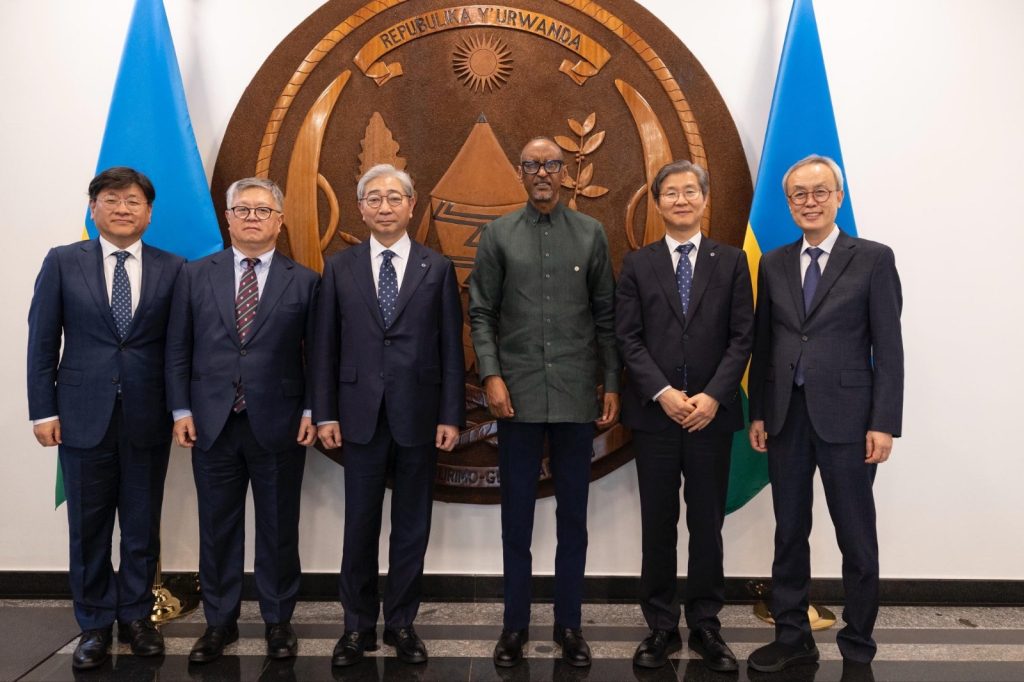

President Paul Kagame on Tuesday received a high-level delegation from South Korea’s Yonsei University at Urugwiro Village, marking a significant step forward in strengthening academic cooperation between Rwanda and one of Asia’s leading institutions of higher learning. The delegation was led by Yonsei University President Prof. Dong-Sup Yoon, accompanied by senior university officials, including Dr. Won-Yong Lee, Executive Vice President for Research Affairs.
The meeting focused on expanding collaboration inhigher education, with discussions centered on academic exchange programs, joint research initiatives, and capacity-building efforts aimed at supporting Rwanda’s long-term development goals. Both sides emphasized the importance of knowledge partnerships in driving innovation, skills development, and sustainable growth.
Yonsei University, widely recognized for its strengths in research, technology, medicine, and global education, has an established reputation as one of South Korea’s top universities. Rwandan officials noted that deeper engagement with such institutions aligns with the country’s vision of becoming a knowledge-based economy, supported by a highly skilled workforce and strong research capacity.
During the discussions, President Kagame highlighted Rwanda’s commitment to investing in education as a cornerstone of national transformation. He underscored the role of international academic partnerships in enhancing the quality of higher education, promoting innovation, and equipping young people with the skills needed to compete in a global economy. The meeting also explored ways in which collaborative research could address shared challenges, including public health, digital transformation, climate resilience, and sustainable development.
The proposed academic exchange programs are expected to create opportunities for Rwandan students and faculty to study, teach, and conduct research at Yonsei University, while also welcoming South Korean scholars to Rwanda. Such exchanges would foster cross-cultural learning, knowledge transfer, and long-term institutional links between the two countries.
Capacity-building initiatives featured prominently in the talks, particularly in areas related to research management, graduate training, and the development of centers of excellence within Rwanda’s higher education system. Officials discussed the potential for joint programs that could strengthen local universities, enhance research output, and support innovation ecosystems.
The engagement with Yonsei University also reflects the growing depth of Rwanda–South Korea relations, which have expanded across sectors including education, technology, health, and economic development. Observers note that academic cooperation plays a strategic role in these ties, serving as a foundation for broader collaboration in science, innovation, and human capital development.
As Rwanda continues to position itself as a regional hub for education and innovation, partnerships with globally recognized institutions like Yonsei University are seen as critical to achieving these ambitions. The meeting at Urugwiro Village concluded with a shared commitment to advancing discussions and translating ideas into concrete programs that will benefit students, researchers, and institutions in both Rwanda and South Korea.
The visit underscores Rwanda’s broader strategy of leveraging international partnerships to strengthen its education sector, expand research capacity, and prepare its population for the demands of a rapidly evolving global economy.