
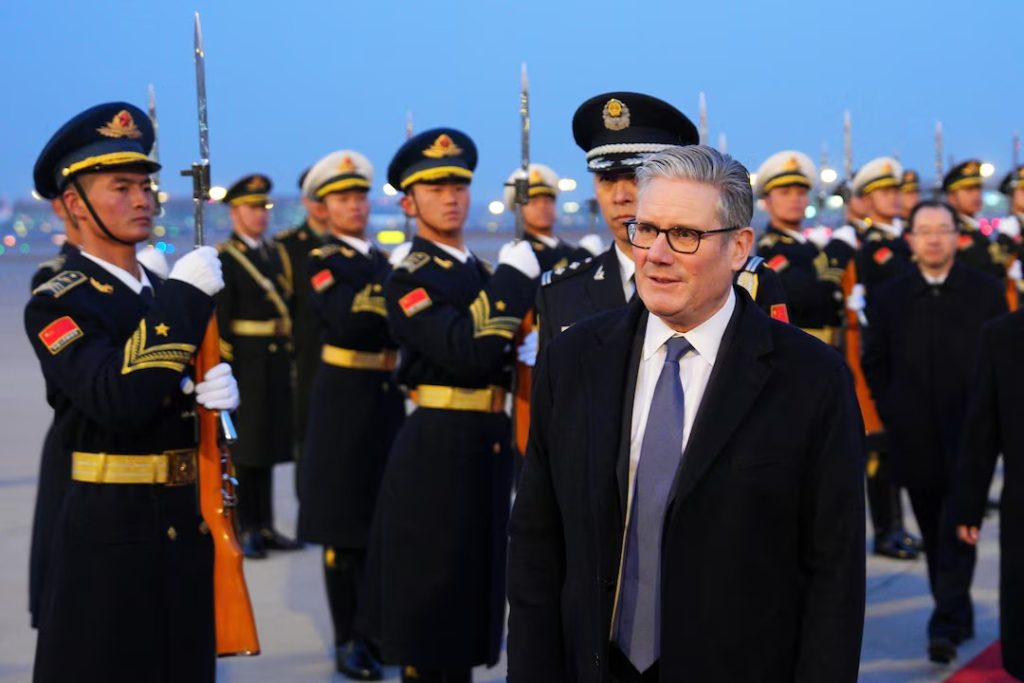

British Prime Minister Keir Starmer arrived in Beijing on January 28, 2026, for a landmark visit aimed at strengthening political and economic ties with China. This is the first UK prime ministerial visit to China in eight years and comes amid global economic uncertainty and shifting alliances under the U.S. administration of President Donald Trump.
Starmer leads a delegation of over 50 senior business and cultural representatives, with a mission to secure new trade agreements, investment opportunities, and technological partnerships. In a statement before departure, the prime minister emphasized that the UK seeks a “strategic and consistent partnership” with China one that benefits British businesses and workers without compromising its alliance with the United States.
During the visit, Starmer is scheduled to meet Chinese President Xi Jinping and Premier Li Qiang to discuss trade, green energy, healthcare, manufacturing, and technology. Chinese officials have expressed readiness to deepen economic cooperation and sign agreements aimed at fostering mutual growth. According to Reuters, Starmer’s visit highlights London’s pragmatic approach: pursuing economic opportunity while safeguarding national security and addressing sensitive issues, including human rights concerns such as the imprisonment of British citizen Jimmy Lai under Hong Kong’s national security law.
Bilateral trade between the UK and China remains robust, with goods trade valued at over $100 billion in 2025, making China one of Britain’s most significant trading partners. While critics warn of potential security risks and political pressures, Starmer maintains that engagement with China is vital to expanding markets, creating jobs, and strengthening the UK’s global economic position.
The outcomes of this visit are expected to shape UK–China relations for years to come, balancing opportunity with caution in a complex international landscape.