

The United States and Armenia have signed a major civil nuclear cooperation agreement, a move widely seen as signaling Yerevan’s determination to reduce its long-standing dependence on Russia and diversify its international partnerships.
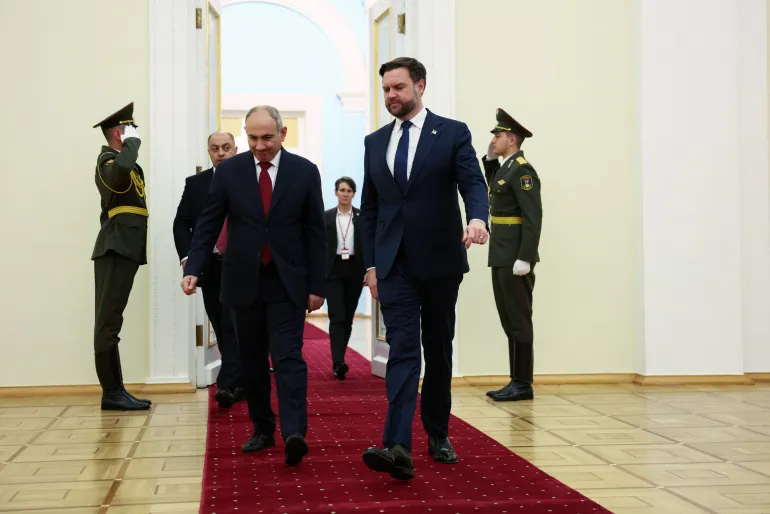
The agreement was signed on Monday in Yerevan by Armenian Prime Minister Nikol Pashinyan and US Vice President JD Vance, who is on a two-day official visit. Known as a 123 Agreement, the deal allows the United States to license nuclear technology and equipment to Armenia, opening the door to billions of dollars in investment and exports.
Speaking at a joint press conference, Pashinyan described the deal as a turning point in bilateral relations. “This agreement will open a new chapter in the deepening energy partnership between Armenia and the United States,” he said.
Vance said the cooperation could lead to up to $5bn in initial US exports, with a further $4bn in long-term fuel supply and maintenance contracts. He added that the agreement focuses on small modular reactors, a newer nuclear technology Washington is increasingly promoting as a safer and more flexible alternative to traditional nuclear plants.
Reducing reliance on Russian energy
Armenia currently relies on a single nuclear power plant at Metsamor, built with Russian technology and nearing the end of its operational life. For decades, Russia has dominated Armenia’s nuclear and broader energy sector, reinforcing Moscow’s influence over the South Caucasus country.
Yerevan has been reviewing proposals from companies in the US, Russia, China, France and South Korea to build a replacement reactor. Analysts say the agreement with Washington significantly increases the likelihood of a US-backed project being selected, a development that would weaken Russia’s traditional grip on Armenia’s energy infrastructure.
Political analyst Narek Sukiasyan told Reuters that diversifying nuclear cooperation has become a political priority. “Given Armenia’s multiple dependencies on Russia, it is essential to diversify partners,” he said. “The United States seems to be the preference now.”
Russia has reacted cautiously. Deputy Foreign Minister Mikhail Galuzin said Moscow’s proposal remained the best option, arguing that Russia’s state nuclear corporation Rosatom offers proven technology and competitive financial terms.
Part of a broader geopolitical realignment
Vance’s visit is the first by a sitting US vice president or president to Armenia and comes six months after Armenia and Azerbaijan signed a US-brokered agreement in Washington, seen as an initial step toward peace after decades of conflict.
Beyond nuclear cooperation, Vance is also promoting the Trump Route for International Peace and Prosperity (TRIPP), a proposed 43km corridor across southern Armenia that would link Azerbaijan to its exclave of Nakhchivan and onward to Turkiye. The route is designed to improve trade and energy connections between Asia and Europe while bypassing Russia and Iran.
The corridor would include modernised rail infrastructure, oil and gas pipelines and fibre-optic cables, and is being presented as a transformative project for the conflict-prone South Caucasus.
“We’re not just making peace for Armenia,” Vance said. “We’re also creating real prosperity for Armenia and the United States together.”
Vance is expected to continue his regional tour with a visit to Azerbaijan later this week, underscoring Washington’s growing diplomatic and economic engagement in a region long dominated by Russian influence.
Source: Al Jazeera