
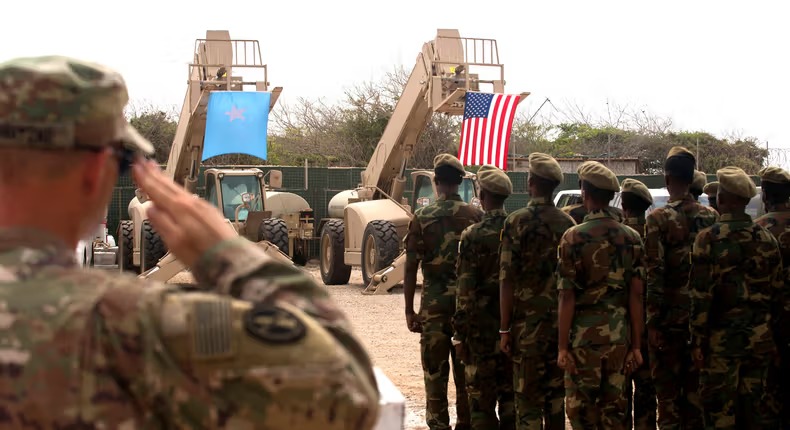

Despite broader regional efforts to limit United States military expansion in Africa, Somalia and Somaliland have both offered Washington access to key ports and air bases, underscoring intensifying geopolitical competition in the Horn of Africa.
As reported by Business Insider Africa, Mogadishu has formally proposed renewing a military agreement granting the U.S. access to strategic infrastructure, reinforcing its long-standing security partnership with Washington.
Somalia Renews 1980 Security Framework
In 2025, Somalia confirmed it would grant the United States exclusive access to strategic air bases and ports, according to correspondence from President Hassan Sheikh Mohamud to U.S. President Donald Trump.
The proposal included the Balidogle and Berbera air bases, as well as the ports of Berbera and Bosaso. Somali officials say the offer builds on a 1980 agreement that already provides a legal framework for U.S. military cooperation.
Ali Mohamed Omar Balcad, Somalia’s State Minister for Foreign Affairs, described the renewed proposal as the “appropriate and lawful channel” for any future security collaboration, emphasizing federal authority over international defense agreements.
Somaliland’s Strategic Counteroffer
The situation is complicated by Somaliland, the self-declared republic that broke away from Somalia in 1991 but lacks full international recognition. Somaliland has separately offered the United States access to key infrastructure, including the strategically located Berbera port and airstrip, in exchange for diplomatic recognition.
Khadar Hussein Abdi, Somaliland’s minister of the presidency, has publicly stated that the region is willing to grant the U.S. exclusive access to its mineral resources and military facilities.
However, while Somalia can make diplomatic offers regarding Berbera, the port is physically controlled by Somaliland and operated in partnership with DP World, creating a delicate balance between legal sovereignty and practical control.
A Strategic Corridor Under Global Spotlight
The Horn of Africa sits along vital shipping routes connecting the Red Sea to the Indian Ocean. Its proximity to the Gulf of Aden, a major artery for global trade and energy flows, makes it strategically invaluable to global powers.
For the United States, access to ports and airfields in the region supports counterterrorism operations against al-Shabaab, strengthens maritime security, and ensures logistical flexibility in a volatile corridor.
At the same time, analysts note that strategic positioning in the region carries broader implications, including influence over Red Sea stability and access to critical mineral resources.
A High-Stakes Geopolitical Balancing Act
Somalia’s renewed outreach signals its intent to assert sovereignty while securing Washington’s strategic commitment. Meanwhile, Somaliland’s parallel engagement reflects its pursuit of international recognition through security and economic incentives.
As competition intensifies in the Horn of Africa, both territories are leveraging geography and infrastructure to attract U.S. interest, turning ports and air bases into powerful diplomatic bargaining chips in a rapidly shifting geopolitical landscape.