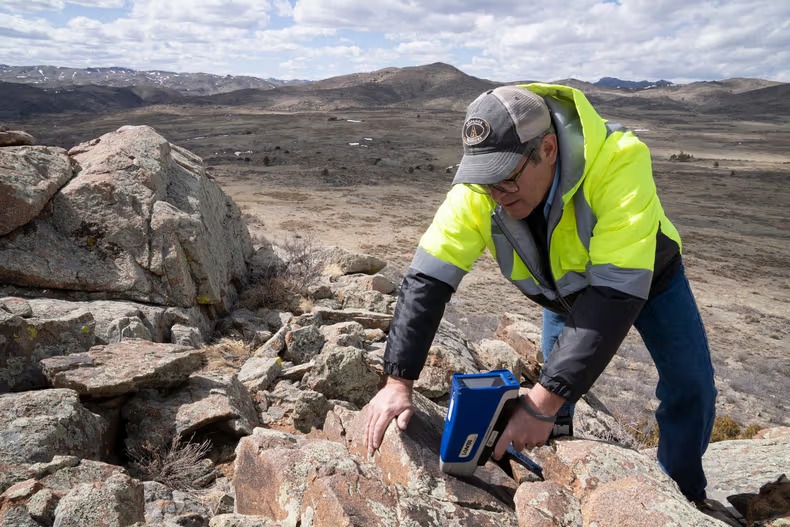

Canadian mineral exploration company Tsodilo Resources Limited has announced a significant rare earth and critical minerals discovery in north-western Botswana, a development that could strengthen Western efforts to diversify supply chains away from China.
According to Business Insider Africa, the discovery was made at the company’s Gcwihaba Metals Project near Shakawe and includes a high-grade polymetallic system containing all 15 rare earth elements listed on the U.S.
Geological Survey’s 2025 Critical Minerals List. In addition to rare earths, the deposit contains copper, cobalt, nickel, vanadium and silver, minerals essential for electric vehicles, renewable energy systems, battery storage, defence electronics and telecommunications infrastructure.
High-Grade Deposit Confirmed Through Drilling
Tsodilo said the targets, identified as C26 and C27, were initially detected as geophysical anomalies through ground magnetic and gravity surveys. Follow-up diamond core drilling confirmed the presence of skarn-type mineralisation between 20 and 50 metres below the surface.
The relatively shallow depth of the deposit could improve prospects for future commercial extraction, although further feasibility studies, environmental impact assessments and regulatory approvals will be required before development moves forward.
Strategic Importance for Botswana
Botswana has traditionally been known for its diamond industry, largely anchored by its long-standing partnership with De Beers Group. However, in recent years, the government has intensified efforts to diversify its mining sector beyond diamonds.
The Botswana Chamber of Mines has emphasised exploration for base metals and critical minerals as a national priority aimed at reducing economic reliance on diamonds and attracting new foreign investment. Botswana is widely regarded as one of Africa’s most mining-friendly jurisdictions, offering regulatory stability, established infrastructure and a strong record of cooperation between government and private operators.
A viable rare earth development would significantly broaden the country’s export base and strengthen its position within global clean energy and advanced manufacturing supply chains.
Rising Global Competition for Rare Earths
The discovery comes amid growing geopolitical competition over rare earth elements. China currently dominates global rare earth processing through major state-backed firms such as China Northern Rare Earth Group. This dominance has prompted the United States and European Union to accelerate policies aimed at securing alternative sources of supply from stable jurisdictions.
Demand for rare earths and other critical minerals is projected to surge in the coming years as countries expand renewable energy capacity, scale up electric vehicle production and modernise defence systems.
Tsodilo said it will continue exploration work to further define the scale and quality of the mineralisation while engaging with local authorities and host communities. Any future project development will remain subject to environmental and regulatory approvals.
If confirmed as commercially viable, the Gcwihaba discovery could position Botswana as an emerging player in the global race for strategic minerals.