
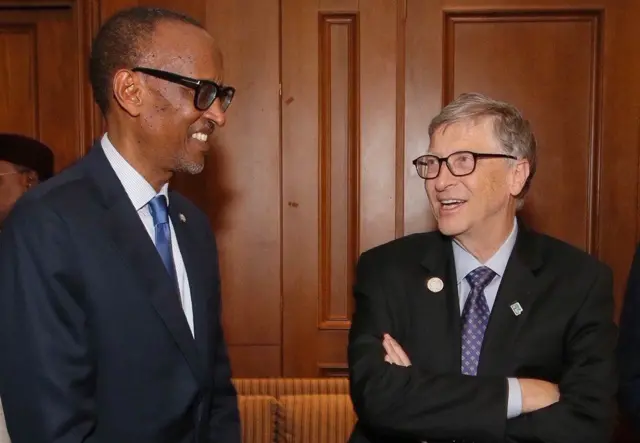

According to reliable sources, besides visiting the factory, Gates is also expected to tour Mwulire Health Center and meet with a community health worker to better understand how Rwanda’s healthcare system functions from the village level upward.
People who met Gates during the visit said that despite being one of the world’s most influential figures, he kept his trip simple and low-profile. His itinerary also includes meeting and sharing meals with different people at a hotel in Rwamagana.
The projects Gates is visiting are among those supported by the Gates Foundation, where he serves as Chair of the Board.
The TKMD syringe manufacturing plant, located in the Mwulire Industrial Park in Rwamagana, was officially inaugurated on April 1, 2025. It initially had the capacity to produce between 600,000 and one million syringes per day.
The factory started operations with 110 employees, 80% of whom are women. Before being released to the market, its syringes underwent rigorous quality testing to ensure they met international standards.
The first syringes produced at the plant were purchased by UNICEF for distribution to countries including Ethiopia, Burundi, the Democratic Republic of the Congo, and Mozambique.
According to CNBC Africa, TKMD has produced more than 22 million syringes since 2024 and has secured a UNICEF contract to manufacture an additional 150 million syringes.
Producing syringes in Rwanda is expected to reduce delivery times to countries in East, Central, and Southern Africa by up to 90%.
Gates: Africa Must Build Its Own Medical Supply Chains
Bill Gates said the COVID-19 pandemic demonstrated the importance of having reliable local manufacturing and distribution systems for medicines, vaccines, and other medical supplies.
He noted that when many African countries struggled to access vaccines, syringes, and essential medical equipment during the pandemic, it became clear that relying entirely on products manufactured overseas could put millions of lives at risk.
According to Gates, factories like TKMD not only manufacture life-saving medical supplies but also create jobs, strengthen Africa’s ability to respond to future disease outbreaks, and contribute to sustainable economic development.
Praises Rwanda’s Healthcare Achievements
Before arriving in Rwanda, Gates said he wanted to learn from the country’s long-term investments in people, strong institutions, and community-based service delivery.
He highlighted that since 2000, Rwanda has reduced under-five child mortality by 80% and maternal mortality by 85%.
“What impresses me is not one single achievement, but the way Rwanda’s long-term investments in people, strong institutions, and community services are producing remarkable results,” Gates said.
He attributed these achievements to sustained investment in primary healthcare, support for community health workers, and the strengthening of institutions such as the Rwanda Biomedical Centre (RBC).
This explains why his visit includes touring Mwulire Health Center and meeting a community health worker to observe firsthand how healthcare services are delivered close to communities, including maternal care, early disease detection, and patient referrals.
Gates also said he looks forward to meeting government leaders, frontline health workers, researchers, students, and innovators.
“I’m eager to better understand how they work individually and together to continue improving people’s lives,” he said.
Focus on Technology and Artificial Intelligence
Gates’ visit also focuses on Rwanda’s use of technology and artificial intelligence to improve healthcare services.
He highlighted the country’s National Health Intelligence Center, which integrates data on patients, treatments, medicines, medical supplies, health insurance, healthcare workers, and civil registration into one system.
This integrated data platform enables health authorities to make faster, evidence-based decisions.
The Gates Foundation is also supporting the Horizon 1000 initiative, which aims to equip 1,000 primary healthcare facilities with AI-powered tools by 2028.
$200 Billion Commitment to Africa
Gates’ visit comes shortly after the Gates Foundation announced plans to invest $200 billion over the next 20 years, with a significant portion of the funding earmarked for projects that benefit Africa.
He emphasized that while international partners will continue to play an important role, Africa’s long-term development will ultimately depend on strong leadership, resilient institutions, and solutions designed by Africans themselves.