
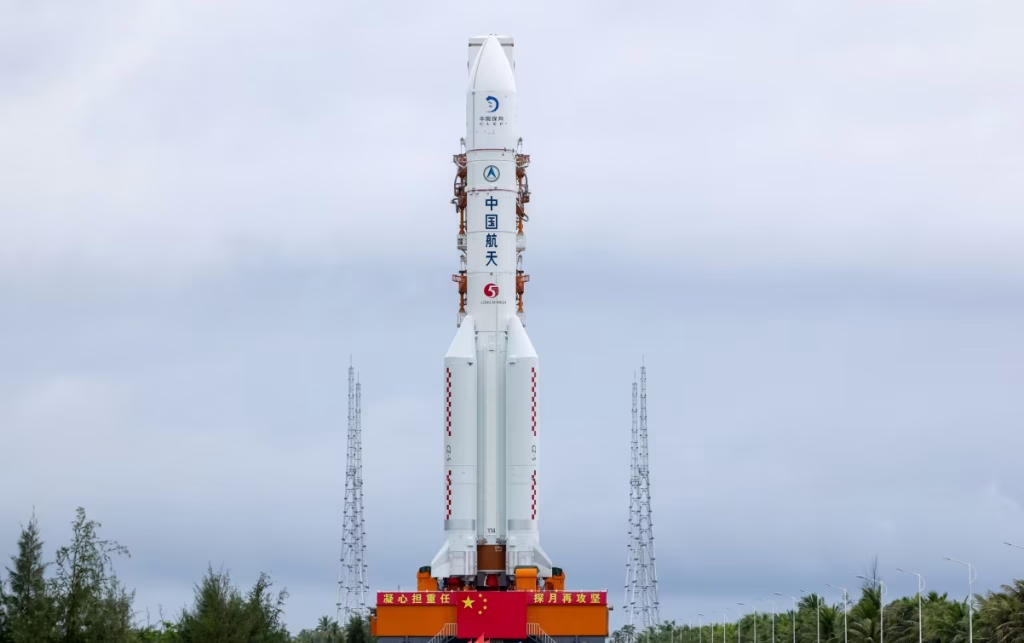

The robotic mission had been expected to launch from Hainan Province in southern China as early as Sunday evening or Monday morning, Beijing time.
However, the China Manned Space Engineering Office announced that the mission could not proceed during its planned launch window this year.
In a statement shared by Chinese state media, officials said an assessment had been carried out based on the principles of “prudence, reliability and absolute mission success.”
The exact reason for the postponement was not immediately disclosed.
Wiphu Rujopakarn, executive director of Thailand’s National Astronomical Research Institute, told CNN that the mission could now be delayed until next year, possibly launching during one of two windows in spring or mid-summer.
Thailand’s NARIT is among seven international partners that had prepared scientific instruments for the Chang’e-7 mission.
Rujopakarn said the delay appeared to be largely linked to weather conditions, particularly high-altitude winds associated with a weather system moving through southern China. He added that the mission’s highly complex nature and the narrow launch window also contributed to the lengthy postponement.
Chang’e-7 is expected to be one of China’s most ambitious lunar missions, with the goal of directly investigating the presence of water ice at the Moon’s south pole.
The mission includes a lander and a robotic “hopper” designed to move into difficult-to-reach craters and drill for possible ice deposits.
The search for water has become a major focus of the growing space race between China and the United States, as frozen water could support future human settlements on the Moon.
If available in sufficient quantities, lunar water could potentially be converted into drinking water, breathable oxygen and even rocket fuel.
The United States is also preparing several missions targeting the Moon’s south pole. Astrobotic Technologies could launch its Griffin lander as early as late 2026, while Blue Origin is planning robotic lunar missions that could include NASA’s VIPER rover, designed to search for water ice and other resources.
Scientists say the Chang’e-7 mission could play an important role in determining whether the Moon’s south pole contains enough usable water to support future lunar exploration.
The delay, however, means China’s ambitious attempt to unlock the Moon’s resources will have to wait.