
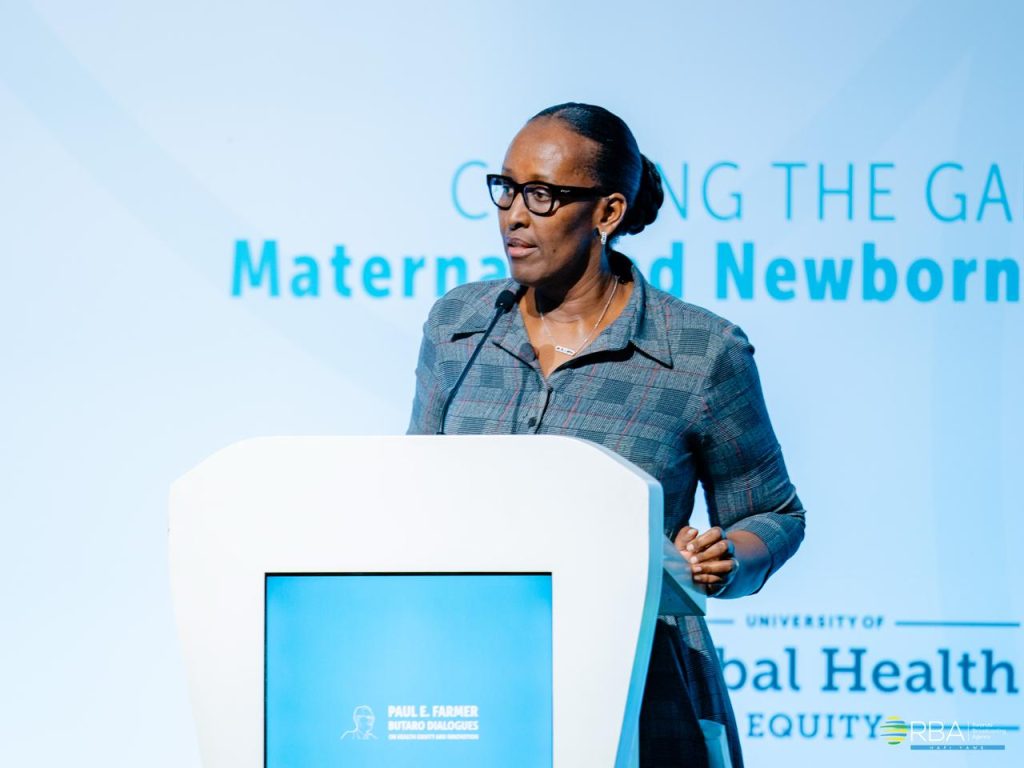

First Lady Jeannette Kagame has called on healthcare professionals, researchers, and university students to prioritize innovation and develop policies aimed at further reducing maternal and under-five child mortality while strengthening inclusive primary healthcare.
The event, known as the Paul E. Farmer Butaro Dialogues, was organized by the University of Global Health Equity (UGHE) in partnership with the Consortium of Medical Schools–Africa (COMS-A).
The dialogue brought together government officials, academics, researchers, representatives from universities, development partners, healthcare professionals, civil society organizations, students, and young innovators.
UGHE Vice Chancellor Prof. Philip Cotton urged the international community to rethink its investment priorities in global health.
“Today, we call on the global health community to examine the gap between what we claim to value and what we actually invest in, and then work together to close that gap.”
Jeannette Kagame said it was inspiring to witness the enduring legacy of Paul Farmer, the founder of UGHE, who believed that every human life has equal value and that no one should be left behind.
“His unwavering commitment to justice for those often overlooked is even more relevant today than ever before.”
She noted that Butaro was the place Paul Farmer chose to establish an institution dedicated to world-class education, research, and healthcare for local communities—a vision that has now become a reality.
The First Lady said the dialogues are built around education, community engagement, and healthcare systems that connect generations.
“Quality healthcare begins where people live. We want meaningful community engagement that reaches everyone. The trust built by a community health worker in a single household should become a model for the entire nation. We are committed to creating systems that connect generations. Students and experienced leaders must work together to shape the future so that knowledge is preserved and progress is sustained.”
She emphasized that while integrating education, research, and public policy, stakeholders must also remain faithful to Paul Farmer’s vision of healthcare for all.
Jeannette Kagame expressed concern that despite remarkable advances in science and technology, women continue to face preventable risks during pregnancy and childbirth.
“We cannot celebrate scientific and technological progress while women still lose their lives simply because they are giving life.”
She added:
“That reality makes every preventable maternal or infant death even more heartbreaking. Our challenge today is not a lack of solutions, but ensuring that proven interventions reach every mother and every child without leaving anyone behind.”
She stressed that early detection and effective treatment of pregnancy-related complications significantly reduce maternal mortality.
The First Lady also called for greater efforts to ensure that quality primary healthcare services are accessible to every woman, whether she lives in urban or rural areas.
She pointed to Rwanda’s experience as proof that sustainable progress is achieved through sound policies, clear priorities, effective coordination among institutions, and accountability at every level.
Over the past three decades, Rwanda has reduced its maternal mortality ratio from 1,071 to 149 deaths per 100,000 live births.
During the same period, under-five mortality declined from 196 to 36 deaths per 1,000 live births.
She reiterated the need to strengthen primary healthcare, bring services closer to communities, harness technology, promote innovation, build domestic capacity instead of relying heavily on foreign aid, and deepen partnerships.