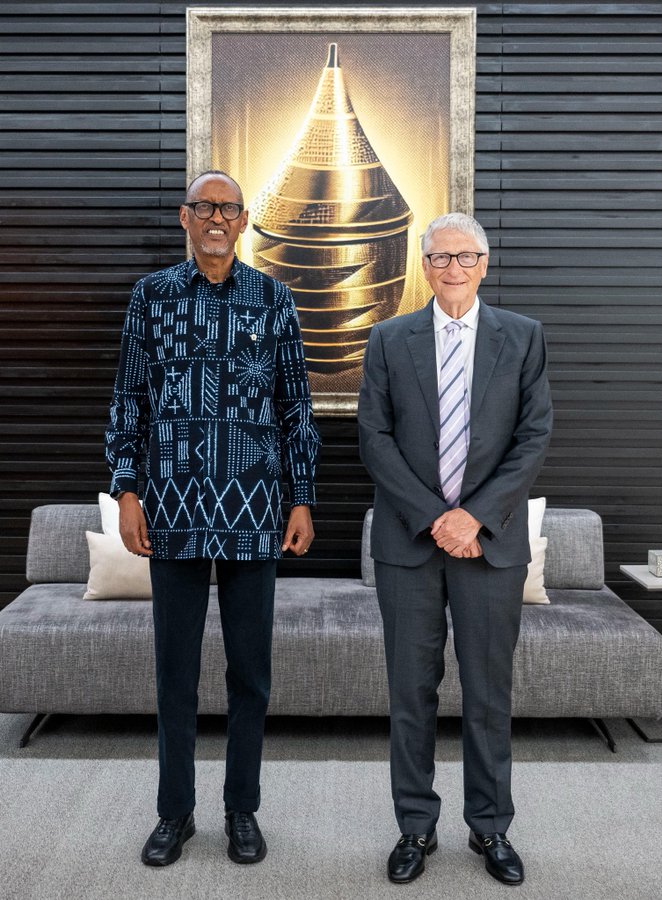

President Paul Kagame has held talks with Bill Gates, Founder and Chair of the Gates Foundation, focusing on strengthening cooperation between Rwanda and the Foundation in key sectors including healthcare, agriculture, artificial intelligence (AI), and digital infrastructure.
According to Rwanda’s Presidency, Village Urugwiro, the two leaders discussed ways to deepen their long-standing partnership and accelerate joint efforts to improve the lives of Rwandans.
A statement from Village Urugwiro said the discussions focused on expanding collaboration in healthcare, agricultural development, artificial intelligence, and technology infrastructure to support Rwanda’s continued development.
Before meeting President Kagame, Gates visited a medical syringe manufacturing plant in Rwamagana District, one of the initiatives supported by the Gates Foundation to strengthen Africa’s capacity to produce essential medical supplies.
He was also scheduled to visit Mwulire Health Centre and meet with a community health worker to gain first-hand insight into how Rwanda’s healthcare system operates from the village level.
Earlier in the day, Gates visited the Kigali Genocide Memorial, where he paid tribute to more than 250,000 victims of the 1994 Genocide against the Tutsi buried at the site. He also learned about Rwanda’s journey of recovery and reconstruction.
In the memorial’s visitors’ book, Gates praised Rwanda’s remarkable recovery following the genocide.
“It is inspiring to see how Rwanda has rebuilt after the tragedy of the genocide and is now building a strong nation. This memorial is essential to ensuring that the victims of the genocide are never forgotten,” he wrote.
Ahead of his visit, Gates said he wanted to learn from Rwanda’s approach to investing in its people, building strong institutions, and delivering services effectively to citizens.
He noted that since 2000, deaths among children under the age of five in Rwanda have fallen by 80%, while maternal deaths related to pregnancy and childbirth have declined by 85%.
Gates attributed these achievements to sustained investment in primary healthcare, support for community health workers, and the strengthening of institutions such as the Rwanda Biomedical Centre (RBC), describing Rwanda as a powerful example of how long-term investment in people can deliver transformative results.