
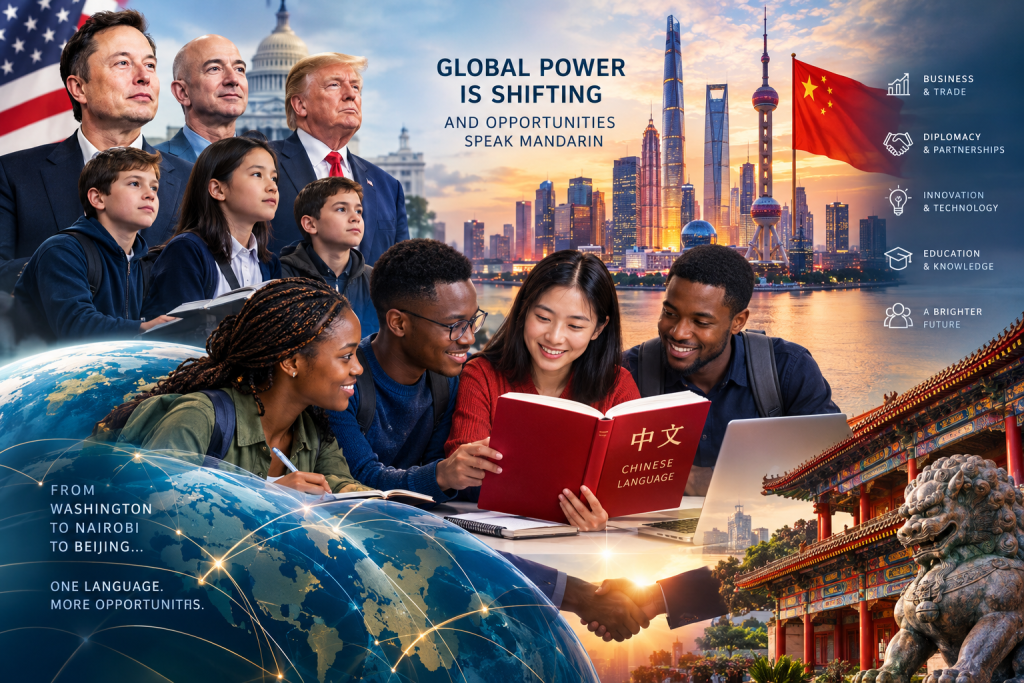

For a quick reader scrolling through international news, the story may appear straightforward: some of the world’s wealthiest and most influential families, including those of Elon Musk, Jeff Bezos and US President Donald Trump, have reportedly shown an interest in having their children learn Mandarin.
But beyond the fascinating headlines lies a much more consequential story about wealth, foresight, global influence and the future of international relations.
One thing I have come to appreciate about successful investors is that they never wait for the rest of the world to recognise an opportunity before positioning themselves to benefit from it. As the saying goes, “The early bird catches the worm.” Their decisions are often investments in a future that may not yet be obvious to everyone else. That is Mandarin.
The growing interest in Mandarin among influential families deserves to be examined through this lens. Although the educational choices of individual families cannot, on their own, establish a global trend, they raise an important question: Why would families with access to virtually every educational opportunity consider Mandarin a worthwhile investment?
My interpretation is simple. They understand that preparing the next generation requires more than preserving today’s advantages. It requires anticipating where tomorrow’s opportunities, partnerships and influence will emerge. Global power is shifting and increasingly handing the steering wheel to China.
China and the changing centre of global economic gravity
The case for learning Mandarin becomes clearer when examined against China’s economic transformation.
According to the World Bank, China’s gross domestic product reached approximately US$19.5 trillion in 2025, maintaining its position as the world’s second-largest economy by nominal GDP. Its population stood at approximately 1.405 billion at the end of that year, representing an extraordinary concentration of consumers, producers, entrepreneurs, researchers and innovators.
The World Trade Organization’s March 2026 Global Trade Outlook reported that China’s merchandise exports reached US$3.77 trillion in 2025. Over the preceding three years, China accounted for an average of approximately 14.4 per cent of global merchandise exports.
These are not merely impressive statistics. They demonstrate the extent to which China has become embedded in the everyday functioning of the global economy. In this context, overlooking Mandarin would mean ignoring one of the increasingly influential languages in which global business is conducted, and money speaks. From smartphones and household appliances to electric vehicles, solar technologies, industrial machinery and telecommunications equipment, Chinese manufacturing serves markets across virtually every income category.
Walk into a commercial district in Kigali, Nairobi, Johannesburg, London or New York, and China’s industrial footprint is difficult to miss. Its manufacturing ecosystem offers products ranging from affordable everyday necessities to sophisticated technologies competing at the highest international standards.
China is therefore more than a market of over one billion people. It is an interconnected economic ecosystem whose decisions increasingly influence production, consumption, supply chains and investment opportunities far beyond its borders. If English became indispensable to generations seeking access to international business, diplomacy and knowledge, Mandarin is increasingly emerging as a mandatory language, I would say, through which the next generation can access significant opportunities.
Mandarin: A New Common Denominator for the Global South and the West
As an African scholar, there is another angle I would not afford to ignore. Perhaps one of the most fascinating dimensions of Mandarin’s growing global appeal is the unusual convergence it is creating between the developed world and the Global South. For generations, young people in developing countries have invested in learning Western languages, particularly English and French, to access international education, employment, trade and economic opportunities. Language proficiency was often a prerequisite for entering a global system whose economic and institutional centres were largely concentrated in the West.
Today, an interesting shift is taking place. American families, including some of the wealthiest and most influential, are recognising the value of learning Mandarin, just as young people in Africa, Asia and Latin America are doing. For once, the West and the Global South are looking towards the same foreign language with a shared ambition: to better understand an emerging Centre of global opportunity and position their next generations to benefit from it.
This is particularly significant for developing countries. Mandarin offers another pathway to international engagement, expanding their ability to negotiate directly with Chinese investors, access educational and technological opportunities, establish commercial partnerships and participate more competitively in global value chains. In this sense, Mandarin is becoming more than a bridge between China and the rest of the world. It is emerging as a common denominator in how both established powers and developing economies prepare for the future. In one of the rare moments in modern economic history, the world’s privileged and those aspiring to greater prosperity are learning the same foreign language, not necessarily to access the West, but to engage with opportunities increasingly associated with China, and that is a momentum every smart person should seize.
Artificial intelligence can translate words. Can it translate trust?
There is an interesting paradox in this emerging enthusiasm for Mandarin. We are living through an extraordinary technological revolution. Artificial intelligence can translate conversations almost instantaneously, interpret documents, generate multilingual correspondence and increasingly facilitate communication between people who do not share a common language.
For the casual observer, the logical conclusion might be that learning a difficult foreign language is becoming unnecessary. Why spend years studying Mandarin when a smartphone can translate a business conversation in seconds? Yet this reasoning overlooks a fundamental distinction between communication and understanding.
An AI-powered application may help an American entrepreneur negotiate the price of machinery with a Chinese manufacturer. It may accurately translate technical specifications, contractual terms and delivery schedules. But successful business relationships are rarely built on transactions alone.
Chinese business culture places considerable importance on relationships, mutual respect and trust, often associated with the concept of guanxi. Understanding the cultural context in which relationships develop can be as important as understanding the words exchanged during a negotiation.
Speaking Mandarin allows a foreign businessperson to engage more directly with Chinese counterparts, appreciate nuances that might otherwise be lost in translation, and demonstrate a genuine willingness to understand their perspectives. It opens access not only to language but also to literature, history, philosophy, social conventions and ways of thinking. Therefore, AI may increasingly eliminate language barriers, but it does not eliminate the strategic value of understanding another society.
What travelling across China taught me about language and development
My own experience travelling through China added another dimension to this reflection.
From Guangzhou to Shanghai, Zhejiang, Hunan, Shenzhen and Beijing, I encountered cities with different economic characteristics, cultural expressions and development priorities. Yet amid this remarkable diversity, something particularly profound caught my attention: the unifying power of a shared national language.
Across these places, Mandarin provided a common medium through which people could study, exchange ideas, conduct business, and participate in national development.
Consider the developmental implications.
A young person can study complex scientific concepts, engage in technological innovation, understand public policy, and participate in national conversations through a language deeply connected to their own society. Researchers, entrepreneurs, policymakers and students can exchange knowledge through a shared linguistic framework.
There is something powerful about a country being able to conceptualise, debate and implement much of its development agenda in its own national language. This observation becomes particularly interesting when viewed from the perspective of the Global South.
In many developing countries, particularly across Africa, education continues to grapple with the relationship between indigenous languages and inherited colonial languages.
Millions of children encounter a difficult transition from learning in their mother tongue to studying increasingly complex subjects in a foreign language. While international languages provide important access to global knowledge, insufficient proficiency can also become an additional barrier to learning. China’s experience offers an important lesson: participation in the global knowledge economy does not require a society to abandon its linguistic identity.
For African countries, the lesson should not be to replace indigenous languages or existing international languages with Mandarin. Rather, it should be to strengthen mother-tongue education while equipping future generations with additional languages that expand their global opportunities.
In this context, learning Mandarin becomes an instrument of connection rather than cultural substitution.
The next generation is being prepared for a different world
This brings us back to the educational decisions of influential American families.
Whether motivated by cultural curiosity, educational enrichment, business considerations or strategic foresight, their interest in Mandarin reflects an important reality: understanding China is becoming increasingly valuable, including for those already occupying privileged positions in the global economy.
Tomorrow’s business leaders, diplomats, technology innovators and policymakers will inherit a world in which China is likely to lead in major economic and geopolitical conversations. Those who understand its language and culture may be better positioned to interpret its priorities, build relationships, identify opportunities and land deals.
This is especially significant for the United States.
Even amid strategic competition between Washington and Beijing, the ability of future American leaders to understand China directly will remain essential. Competition does not diminish the value of understanding one’s counterpart; if anything, it increases it.
The same principle applies to Africa, Europe, Latin America and the wider Global South.
China’s growing international influence is also reflected in the expansion of Chinese-language learning infrastructure. In March 2025, China’s Ministry of Education reported that its Global Chinese Learning Platform had surpassed 16 million users across more than 190 countries and regions.
While platform registrations should not be confused with confirmed language proficiency, the geographical reach illustrates how opportunities to learn Chinese are becoming increasingly accessible.
What is emerging, therefore, is not simply a fashionable interest in a foreign language. It is a broader recognition that future generations will benefit from understanding societies that are shaping the global economic, technological and diplomatic landscape.
Learning Mandarin is an investment in understanding the future
The greatest mistake would be to interpret the growing interest in Mandarin merely as another educational trend among wealthy families.
There is a deeper lesson.
Wealth is not sustained only by understanding the present. It is also sustained through the ability to anticipate change, recognise emerging opportunities and prepare succeeding generations to operate in circumstances different from those inherited by their parents.
Language is one of the most enduring investments in that preparation.
For me, China’s significance is not simply that it represents a vast consumer market or an industrial powerhouse. It is that its economic development, technological capabilities, cultural heritage and growing international engagement have made understanding the country increasingly relevant to understanding the world itself. Hence understanding China through Mandarin offers something that no translation application can fully substitute: the opportunity to engage with its people, ideas and society directly.
Perhaps the most important question is therefore not why some of the world’s wealthiest families want their children to learn Mandarin.
It is why the rest of us should consider this an opportunity worth understanding.
The future will not belong exclusively to those who speak English, Mandarin or any single language. It will increasingly reward those who can move confidently between cultures, understand different centres of influence and build meaningful connections across them.
In that future, learning Mandarin is not simply about learning how to speak Chinese.
It is about acquiring another language through which to understand, negotiate with and participate in a changing world.