

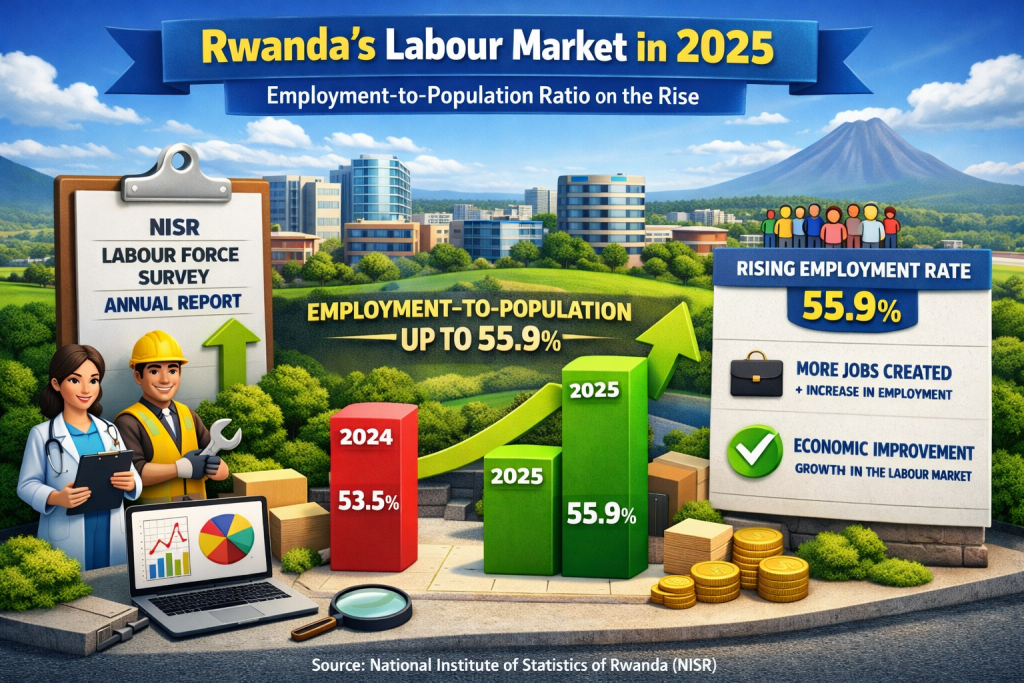
Rwanda’s labour market showed positive signs in 2025, with the employment-to-population ratio rising to 55.9%, up from 53.5% in 2024, according to the latest Labour Force Survey Annual Report released by the National Institute of Statistics of Rwanda (NISR).
Last year, Rwanda’s working-age population of around 8.5 million included about 4.8 million people who were employed. The total labour force, which also counts 676,000 individuals actively looking for work, reached 5.4 million. At the same time, approximately 3.1 million people remained outside the labour force.
Employment growth was observed across both genders. The employment-to-population ratio for men increased by 1.4 percentage points to 63.6%, while women saw a larger gain of 3.1 points, reaching 49%.
The services sector remained the largest employer, accounting for 44.4% of the workforce, up from 42.9% in 2024. Employment in agriculture and industry remained relatively stable.
The unemployment rate fell to 12.4%, down 2.5 percentage points from 2024, meaning about one in eight workers remains jobless. Unemployment remains higher among women (14.2%) compared to men (10.8%), and is particularly pronounced among youth (14.7%) relative to older workers (10.8%). Urban and rural areas saw similar rates of around 12%.
Meanwhile, the labour underutilisation, which includes underemployment and those who are willing to work but not actively seeking employment, increased to 56% in 2025, up 1.8 percentage points from 2024. The rate remains notably higher among women (63.1%) compared to men (48.5%), and slightly higher among youth (56.7%) than adults (55.5%).
Overall, while men continue to participate in the labour force at higher rates than women, the gender gap narrowed slightly to 14.3 percentage points, indicating gradual progress in female workforce participation.
These figures suggest steady improvement in Rwanda’s employment landscape, with declining unemployment and a growing share of the population engaged in productive work, despite ongoing challenges related to underutilisation.