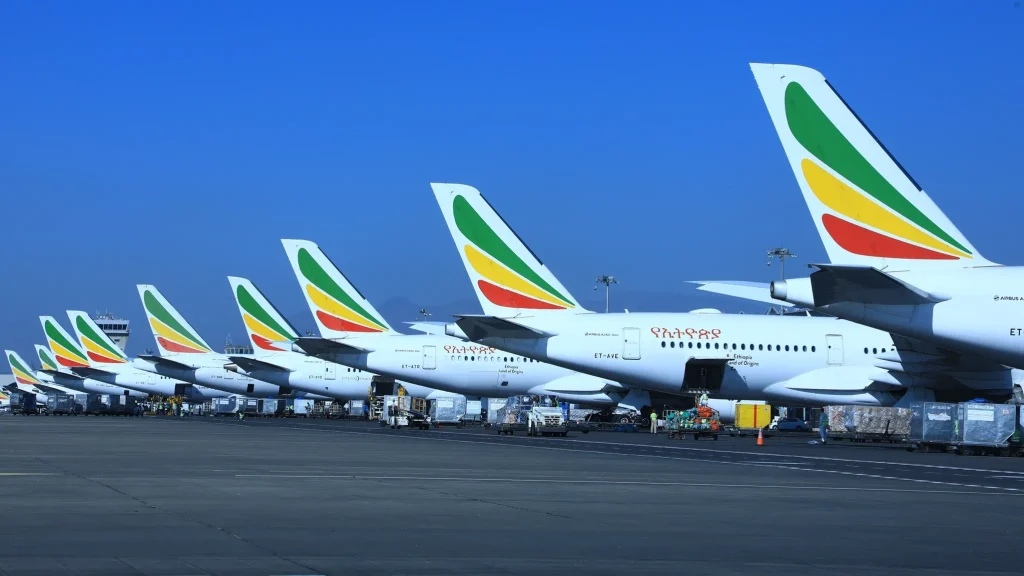
Construction activities are currently underway at Ethiopia’s Bishoftu International Airport, following the official groundbreaking ceremony held on January 10, 2026.
The $12.5 billion mega infrastructure project, led by Ethiopian Airlines Group, Africa’s largest airline, stands among the continent’s most significant aviation investments in recent years. Since the launch ceremony, on-site works have continued steadily as the project transitions from initial groundwork into early construction phases.
The January ceremony was attended by His Excellency Dr. Abiy Ahmed, Prime Minister of Ethiopia, alongside senior government officials, cabinet ministers, aviation stakeholders, industry leaders, and Ethiopian Airlines executives.
Situated about 50 kilometers southeast of Addis Ababa, the new airport is designed to ease pressure on Bole International Airport, which has been operating near full capacity.
Once completed, Bishoftu International Airport is expected to significantly expand Ethiopia’s aviation capacity, handling both passenger and cargo traffic. The first phase is projected to accommodate around 60 million passengers annually, with future expansions expected to further increase capacity.
Ethiopian Airlines views the project as a strategic response to growing air travel demand across Africa, where many passengers currently rely on transit hubs outside the continent for inter-African connections.
The airline is leading the investment, contributing approximately 30% of the total cost through equity financing. The remaining funding, estimated at around $8 billion, is expected from international partners, with discussions involving countries such as China, the United States, and Italy.
However, securing full financing remains a key factor influencing the pace of future construction phases.
According to CNN reports, Beyond passenger operations, the airport is expected to play a major role in cargo logistics, with an annual capacity of up to 3.73 million tons of freight.
This aligns with broader regional ambitions under the African Continental Free Trade Area (AfCFTA), aimed at improving intra-African trade through stronger transport and logistics infrastructure.
The project is being designed by Zaha Hadid Architects, an internationally recognized firm known for landmark airport designs globally.
Inspired by Ethiopia’s Great Rift Valley, the terminal features a central spine branching into multiple concourses, with integrated green spaces and landscaped areas reflecting Ethiopia’s natural and cultural diversity.
Designers say the airport is intended not only as a transport facility but also as a symbolic gateway offering travelers a sense of place.
Sustainability is a central component of the design, with plans including solar energy systems, locally sourced materials, and stormwater management infrastructure aimed at supporting surrounding wetland ecosystems.
However, aviation remains a major contributor to global carbon emissions, accounting for an estimated 2–3% worldwide.
Ethiopian Airlines has highlighted that it has allocated approximately $350 million to support comprehensive resettlement and livelihood restoration programs for affected communities. The initiative includes the construction of modern housing units, alongside improved access to essential public services such as electricity, education, and healthcare, aimed at enhancing living conditions and supporting long-term community development.
Analysts describe the Bishoftu International Airport as a potentially transformative project for African aviation, with the ability to reshape regional and global air connectivity.
However, experts caution that its success will depend on timely financing, coordinated infrastructure development, and supporting systems such as roads, rail, power supply, and customs efficiency.
If completed as planned, the airport could position Ethiopia as a leading aviation hub on the continent and significantly influence global air travel routes.
For now, construction continues in Bishoftu, marking steady progress on one of Africa’s most ambitious infrastructure developments.