
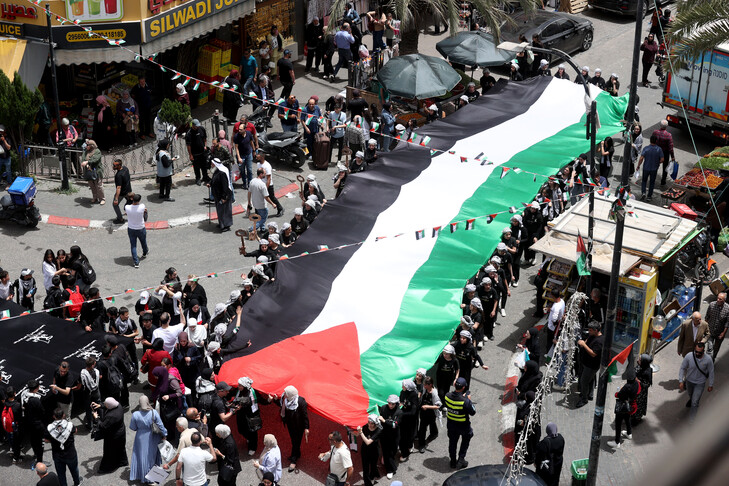

DEIR AL-BALAH, Gaza Strip, Palestinians in Gaza have marked the 78th anniversary of the 1948 Nakba, reflecting on the mass displacement that accompanied Israel’s creation while comparing it to the ongoing war, which many say has brought an even more severe humanitarian disaster.
The Nakba, meaning “catastrophe” in Arabic, refers to the displacement of about 750,000 Palestinians in 1948 and the destruction of hundreds of villages during the conflict surrounding Israel’s establishment. Many of those displaced were never allowed to return, forming long-term refugee communities across Gaza, the West Bank, and neighboring countries.
Among those reflecting on both periods is 78-year-old Yusuf Abu Hamam, a survivor originally from the village of al-Joura, which was destroyed in 1948. He said that only a few stones of the village can still be seen today, while most of the area has since been transformed into modern developments in southern Israel.
Now living in Gaza’s Shati refugee camp, Abu Hamam said the area where his family resettled after 1948 has itself been heavily destroyed in the current war, leaving him with a sense that very little of his past remains intact. He described the situation in Gaza as extremely constrained and difficult, saying the territory has been reduced to a very small and heavily damaged space where normal life has become nearly impossible.
In Khan Younis, families such as Ne’man Abu Jarad’s report being displaced repeatedly since the start of the war, moving from one temporary shelter to another with little stability or security.
His wife, Majida Abu Jarad, said the current situation differs from 1948 because displacement is no longer a single event but a repeated cycle, with families forced to move multiple times and unable to settle in any safe or permanent location.
United Nations estimates indicate that around 90% of Gaza’s population has been displaced, with many living in overcrowded tent camps facing shortages of clean water, food, sanitation, and medical care.
Large parts of Gaza, including Rafah, Beit Hanoun, and Beit Lahiya, have suffered extensive destruction during the ongoing war. Health authorities report tens of thousands of deaths since the conflict began in October 2023, following Hamas’ attack on southern Israel that killed about 1,200 people and resulted in the abduction of 251 hostages.
The 1948 Nakba occurred during the Arab-Israeli war, when hundreds of thousands of Palestinians fled or were expelled from their homes. Around 530 villages were destroyed or depopulated, according to Palestinian records, and refugees were later settled in camps managed by UNRWA, many of which gradually developed into permanent urban areas such as Shati camp.
Residents say the current war has also erased much of their personal and collective history, including homes, family photographs, and official records.
Families in Gaza say the war has taken far more than their homes. Along with destroyed property, many have lost important identity documents, family papers, and personal archives. They describe how years of memories, records, and proof of identity have been wiped out as entire households and community documents were damaged or lost during the fighting.
For many Palestinians in Gaza, the Nakba is viewed as both a historical event and a continuing reality. They describe it as a situation marked by repeated displacement, widespread destruction, and ongoing uncertainty that has affected families across generations.