
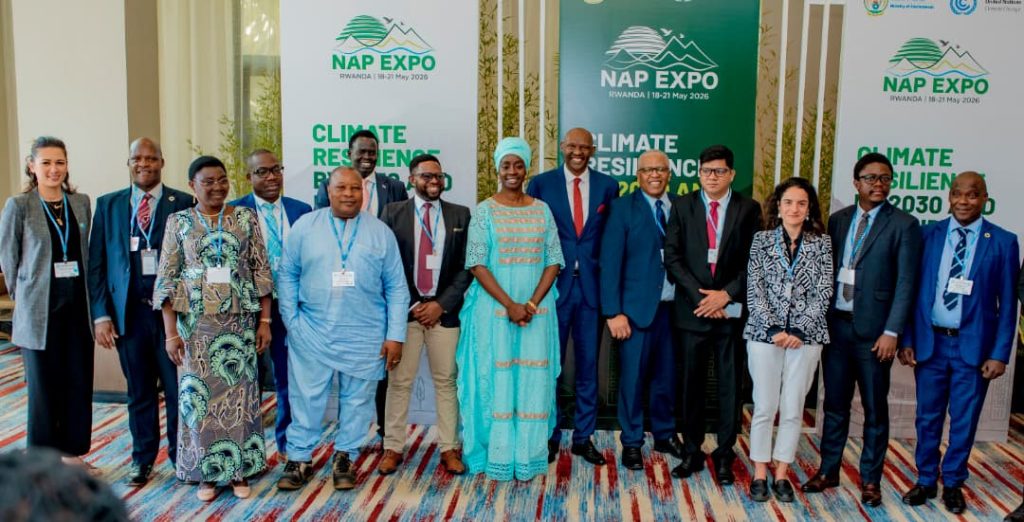

The 11th Global National Adaptation Plan (NAP) Expo, taking place in Kigali, brings together countries and partners with a shared focus on moving beyond climate promises and accelerating the implementation of practical, well-funded adaptation projects to strengthen resilience and deliver real impact worldwide.
Held from May 18 to 21 under the theme “Climate Resilience by 2030 and Beyond,” the high-level gathering has attracted government leaders, climate experts, development partners, and financial institutions from around the world, all focused on one urgent question: how to turn climate plans into real impact on the ground.
From planning to implementation
Opening the Expo on 18 May, officials from the Rwanda Environment Management Authority (REMA) emphasized that climate action must now shift decisively from policy design to execution.
Faustin Munyazikwiye, Deputy Director General of Rwanda Environment Management Authority, highlighted that National Adaptation Plans are already strong tools, but their value depends on implementation.
He stressed that Rwanda is actively aligning climate resilience with its long-term development agenda, including Vision 2050 and its updated Nationally Determined Contributions (NDC 3.0), aiming for a 53% reduction in greenhouse gas emissions by 2035 while strengthening adaptation across key sectors such as agriculture, health, water, transport, and urban development.
He also pointed to ongoing national projects such as Kigali wetland restoration and the Nyandungu Eco-Park, describing them as clear examples of how policy is being transformed into visible environmental and economic benefits.
“Without implementation and financing, even the best strategies remain just documents,” he noted, urging stronger global collaboration to unlock climate investment.
Global partners highlight financing gap
Representatives from the United Nations Framework Convention on Climate Change echoed the same message, noting that many countries are now entering a new phase focused on delivering real adaptation results.
Dr. Paul Desanker emphasized that while countries have made strong progress in developing adaptation frameworks, the next step is to scale up implementation through accessible finance and practical support.
He also highlighted the importance of national climate funding mechanisms, pointing to Rwanda’s Green Fund as a successful model that helps bridge international and domestic financing efforts.
Urgent need for climate finance
The discussion also strongly centered on the widening climate finance gap affecting developing countries.
According to the United Nations Environment Programme’s report released on 29 October 2025, developing countries may require between $310 billion and $365 billion annually by 2035 to meet adaptation needs, around 12 to 14 times current international public funding levels.
Dr. Fatmata Lovetta Sesay, UNDP Resident Representative in Rwanda, described climate change as a present-day reality rather than a distant threat, urging stronger global action.
She noted that despite increasing efforts, financing is not yet growing fast enough to match the scale of climate risks facing vulnerable communities.
“Climate finance is not flowing at the scale needed to protect developing countries & their most vulnerable populations. We must use this NAP Expo to shift from planning to implementation at scale, building a durable foundation for Climate Resilience Beyond 2030, ” Dr.Fatmata.

Turning commitments into opportunity
Despite the challenges, the Expo also highlighted growing optimism, with participants emphasizing that solutions already exist; what is needed now is coordination, financing, and scale.
UNDP showcased its global support, including helping over 100 countries mobilize billions in climate-related grants and co-financing for resilience projects.
Experts from the UNFCCC also noted that the global adaptation agenda is shifting toward measurable, results-driven implementation, where countries are expected to present bankable projects capable of attracting investment.
The Least Developed Countries Expert Group described the NAP Expo as a vital platform for collaboration, learning, and partnership-building among vulnerable nations.
Throughout the event, Kigali has become a hub for climate dialogue and investment matchmaking, connecting governments directly with funders and technical partners.
For Rwanda, hosting the Expo reinforces its rising profile as a regional leader in environmental sustainability and green development. The country continues to position itself as an example of how climate ambition can be integrated into national planning and delivered through practical projects.
As discussions continue during the four-day NAP Expo 2026 in Kigali, a clear and unified message is emerging: climate resilience must move beyond paper commitments and be fully financed, implemented, and scaled to safeguard people, ecosystems, and economies.
The Expo is reinforcing a strong call for enhanced global cooperation, focused on turning adaptation plans into concrete action and ensuring that climate resilience becomes a real and lasting reality for communities around the world.