The report is considered a major milestone because it confirms that Rwanda has successfully completed the first phase and can now move into the second stage, which involves discussions with partners and service providers linked to nuclear energy infrastructure projects.
Before presenting the report to President Kagame, the Director General of the IAEA, Rafael Mariano Grossi, said:
“For some time, we have been working with Rwandan experts on this assessment, and today we are pleased to present the findings to you.”

President Kagame said completion of the first assessment phase aligns with Rwanda’s broader vision of generating electricity from nuclear energy by the early 2030s.
Rwanda plans to build a nuclear power plant using Small Modular Reactors (SMRs), which are compact nuclear reactors manufactured elsewhere and later transported to the site where they will operate.
Each module measures about 1.8 meters in length. Rwanda plans to deploy four modules, each capable of generating 200 megawatts of electricity, with a combined production target of 600 megawatts.
Construction is expected to begin in early 2028 and last approximately two years.
Unlike conventional nuclear power plants, which are very large, SMRs are much smaller and can be compared to the size of storage containers. Increasing the number of modules increases the amount of electricity generated. Each of the SMRs Rwanda intends to use can produce 200 megawatts, with four planned overall.

President Kagame stated that Small Modular Reactors are the most suitable solution for Rwanda and many other African countries.
“For Rwanda, Small Modular Reactors are the practical solution. They fit the realities of many African countries because they can be deployed more easily and connected to smaller electricity grids at lower cost,” he said.
Rwanda recently became the 38th country seeking to generate nuclear electricity by 2050.
President Kagame emphasized that African economies cannot achieve meaningful growth without sufficient electricity supply. He noted that inadequate energy often discourages investors from investing in Africa because of uncertainty around reliable power access.
He also pointed out that global financial institutions have increasingly begun recognizing nuclear energy as a clean energy source deserving financial support.
“That creates new opportunities,” Kagame said.
Looking ahead to 2050, President Kagame said Africa will have one of the world’s largest working-age populations, which represents a major opportunity that must be prepared for now through long-term planning and stronger cooperation among African countries.
IAEA Director General Rafael Mariano Grossi also revealed that the agency recently signed an agreement with the World Bank aimed at helping countries secure financing for nuclear energy projects.
He explained that global financial institutions are now more open to supporting nuclear energy initiatives. Previously, such projects struggled to attract funding because nuclear energy was often viewed mainly as a risk rather than a development opportunity.
Grossi added that after signing the agreement with the World Bank, the IAEA also plans to partner with the African Development Bank to support African countries, following previous cooperation with the Asian Infrastructure Investment Bank.
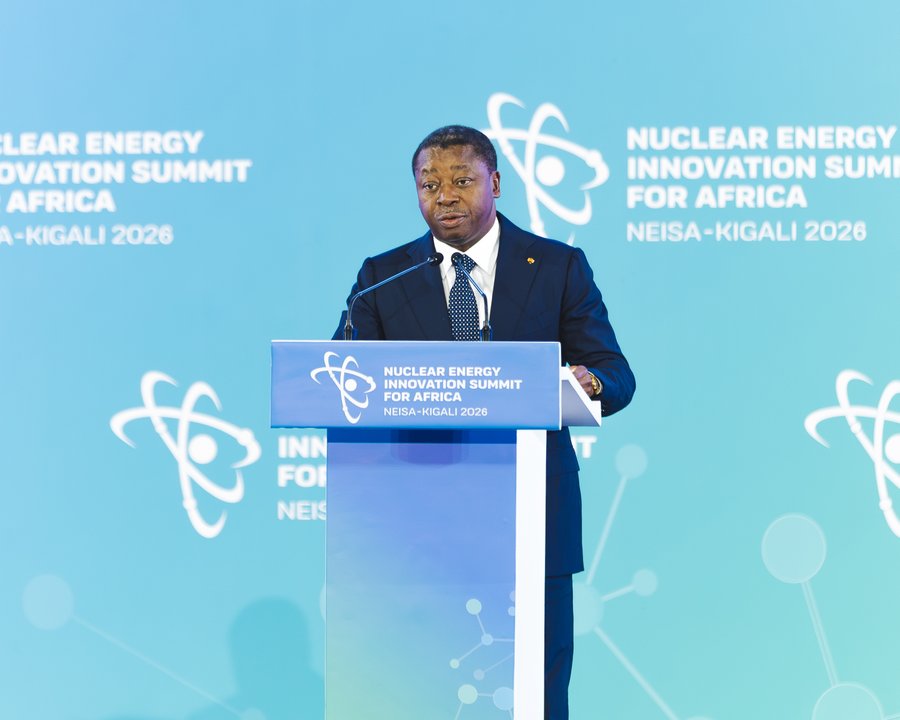
Togo’s President, Faure Essozimna Gnassingbé, also stressed that Africa should not be left behind in nuclear energy development.
He called for stronger systems to promote nuclear energy, train Africans especially women, and ensure the continent gains a meaningful voice in the sector.