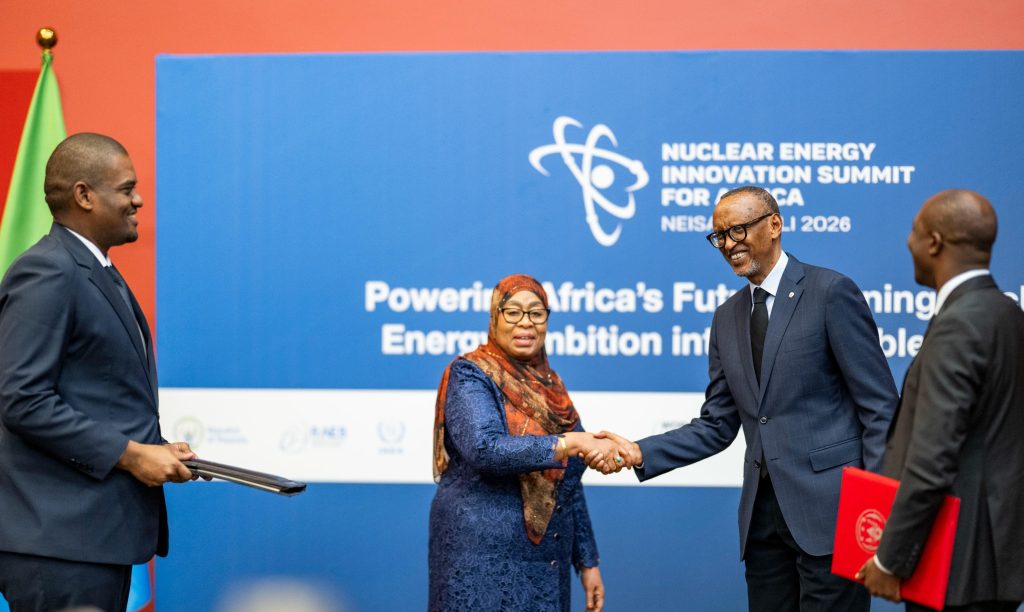
The agreement was signed on May 19, 2026, during the Nuclear Energy Innovation Summit for Africa 2026.
On the sidelines of the Summit, President Kagame and Samia held a bilateral meeting and witnessed the signing of a Memorandum of Understanding on cooperation in the energy sector between the Republic of Rwanda and the United Republic of Tanzania, further committing to advancing shared energy development goals.
The signed agreement aims to strengthen cooperation in key sectors including energy, energy infrastructure development, renewable energy promotion, institutional capacity building, and cross-border collaboration.
It was signed by Rwanda’s Minister of Infrastructure, Jimmy Gasore, and Tanzania’s Minister of Energy, Deogratius John Ndejembi, in the presence of Presidents Kagame and Samia Suluhu Hassan.
Minister Gasore praised the longstanding relationship between the two countries and said the agreement reflects their shared commitment to deepening bilateral ties and regional cooperation, especially in the energy sector.
“On behalf of the Government of Rwanda, we thank the Government of Tanzania for the high-level cooperation, constructive discussions, and collaborative spirit that made this milestone possible,” he said.
He explained that the agreement would support collaboration in mutually beneficial areas such as energy trade, infrastructure development, technical cooperation, and broader efforts aimed at accelerating East African regional integration.
While opening NEISA 2026, President Kagame said nuclear energy is increasingly becoming part of global efforts to promote clean energy and represents a major opportunity for African countries if they work together.
“When countries continue operating individually, progress becomes slower and more expensive. Cooperation in regulation, project financing, and regional energy integration is essential. That is why NEISA is important,” Kagame said.
He added that the focus now should be on turning discussions into concrete action and identifying financing mechanisms capable of accelerating development.
“Rwanda will continue supporting these efforts because this goes beyond any single country,” he said.
During the summit, President Samia Suluhu Hassan praised Kagame for consistently advocating for Africa’s advancement in nuclear energy, noting that although the continent has fallen behind in the sector, it possesses natural resources that could support major development.
Tanzania currently produces about 4,500 megawatts of electricity but expects demand to rise to nearly 8,000 megawatts by 2030 and 70,000 megawatts by 2050.
Meanwhile, Rwanda aims to generate more than 5,000 megawatts of electricity in the future, up from the current 406 megawatts. By 2030, Rwanda plans to operate at least one nuclear power plant capable of generating 600 megawatts.
Rwanda and Tanzania already cooperate on several major energy projects, including the Rusumo Hydroelectric Power Station, which has the capacity to generate 80 megawatts of electricity.
The joint project, shared by Rwanda, Tanzania, and Burundi, is expected to provide each country with 26.6 megawatts of electricity, benefiting approximately 1.146 million people, including 520,000 Burundians, 467,000 Rwandans, and 159,000 Tanzanians.