
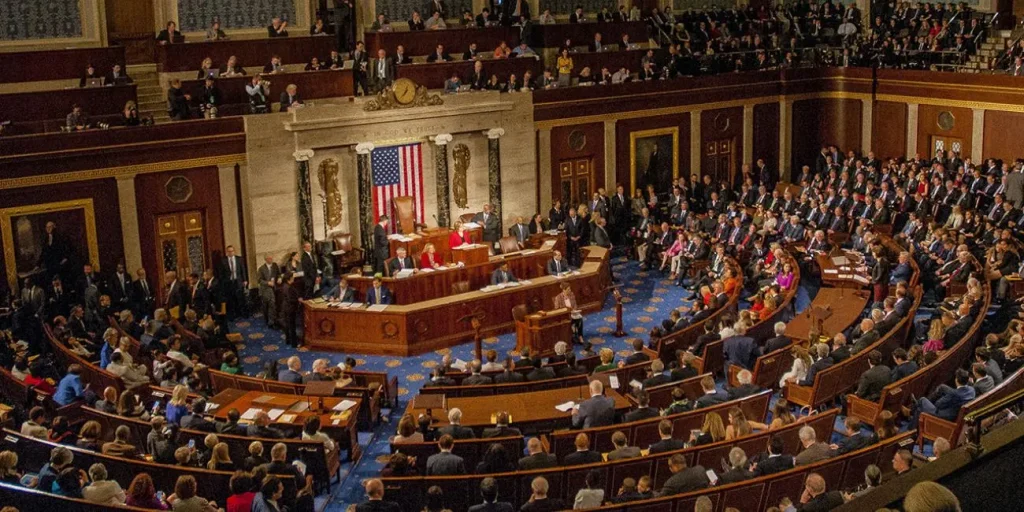

The bill was introduced by Democratic Congressman Gregory Meeks, who argued that the conflict launched by Trump against Iran has had significant negative effects on the U.S. economy and the lives of American citizens.
Meeks stated that the U.S. Constitution grants Congress the authority to oversee major national matters and that its approval is required for critical decisions such as war.
Speaking to reporters, he said Trump has been attempting to use the powers of the presidency to make inappropriate decisions, but that such actions are coming to an end because lawmakers have stepped up to fulfill their constitutional responsibilities.
The House was initially scheduled to vote on the bill on May 21, 2026, but Republican leaders, including House Speaker Mike Johnson, postponed the vote because many lawmakers were absent.
The vote was rescheduled for June 3, 2026. A total of 215 lawmakers, including some Republicans, voted in favor of the bill, while 208 opposed it. As a result, the measure passed the House and will now be sent to the Senate for consideration.
A notable aspect of the bill is that, unlike most legislation, it would not require the president’s signature to take effect. If approved by the Senate, it would become law.
Republican Congressman Thomas Massie of Kentucky said Americans are tired of the war initiated by Trump because it has driven up the cost of living. He claimed that a 3.7-kilogram gas cylinder now costs $5 and that fertilizer has become scarce.
Massie said:
“People are fed up. They are fed up with a $5 gas cylinder, $6 diesel, and the fact that we can’t get fertilizer for our farms in Kentucky.”
He added that the vote sent a strong message that lawmakers, as representatives of the people, are weary of the war against Iran.
House Speaker Mike Johnson argued that the vote is problematic because it would limit Trump’s authority at a time when he has initiated talks aimed at ending the conflict between the United States and Iran.
He said:
“I think it is a very bad idea to strip the administration and the Commander-in-Chief of the authority to negotiate. That is what this measure seeks to do. It weakens us and reduces our leverage in peace negotiations on this issue.”
The United States launched military action against Iran on February 28, 2026, leading to the closure of the Strait of Hormuz, through which 20% of the world’s petroleum products pass, causing major disruptions to the global economy. Trump did not seek congressional authorization before initiating the conflict.
Under U.S. war powers law, a president may not keep U.S. forces engaged in hostilities for more than 60 days without congressional approval, a deadline that has already passed.
Defense Secretary Pete Hegseth disputes that the 60-day limit has expired, arguing that the clock restarted when Trump announced a ceasefire between the United States and Iran ahead of planned negotiations.
However, on June 3, 2026, a team of inspectors general from the Department of Defense, the Department of State, and the former USAID announced that the conflict had indeed exceeded the 60-day limit and that they had begun an official review.
The bill introduced by Meeks would prohibit Trump from continuing the war without publicly seeking and obtaining congressional authorization.
It also reinstates the 60-day deadline requiring the president to seek approval from Congress to continue military operations and to provide lawmakers with a clear justification for the war and an explanation of how long it is expected to last.


