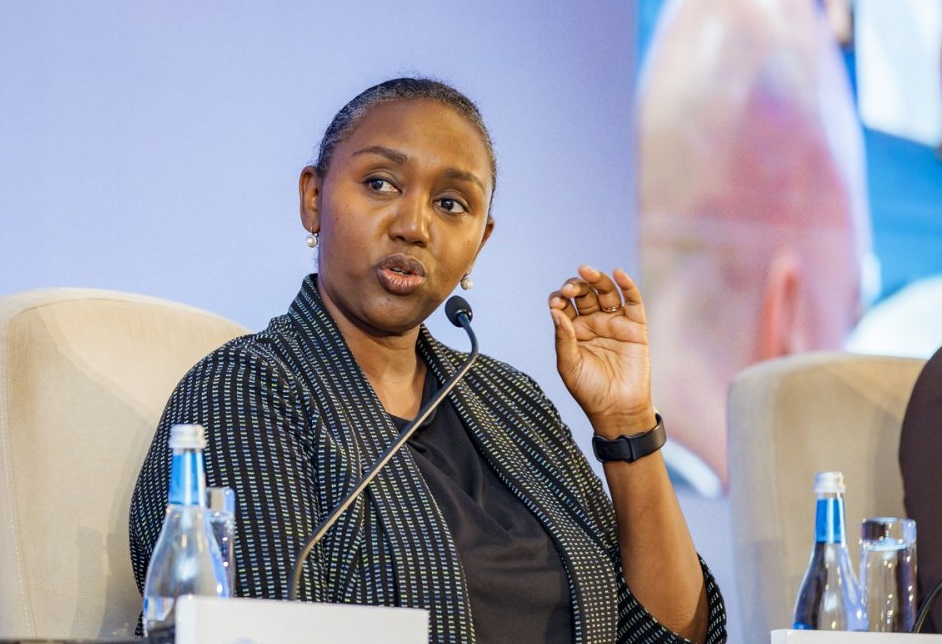

Rwanda’s Government Spokesperson, Yolande Makolo, has criticized a recent report published by Human Rights Watch (HRW) that accuses the Rwanda Defence Force (RDF) of involvement in abuses linked to the ongoing insecurity in eastern Democratic Republic of Congo (DRC).
In the report, HRW largely focuses on Rwanda’s military, portraying it as a key driver of the conflict in eastern DRC and closely linking it to the AFC/M23 rebel movement, to the extent that the two appear indistinguishable. However, according to the Rwandan government, the organization failed to provide conclusive evidence to support these claims.
In a statement issued on Thursday, Yolande Makolo condemned what she described as a recurring pattern in HRW’s reporting on Rwanda.
She argued that for more than three decades, the organization has consistently relied on unnamed sources, failed to conduct investigations on the ground, lacked definitive evidence, and prioritized calls for sanctions.
Makolo questioned HRW’s credibility, saying the organization ignores facts it has acknowledged itself.
“In its latest report, HRW cannot claim to be conducting an impartial investigation while overlooking its own findings that Kinshasa arms, funds, and closely collaborates with the FDLR, Wazalendo militias, foreign mercenaries, and the Burundian army — all forces involved in warfare and humanitarian suffering in eastern DRC,” she said.
Makolo reiterated that Rwanda’s military should not be equated with AFC/M23.
“It must be made clear: the RDF is not AFC/M23. Any credible investigation requires impartiality, access to the locations concerned, solid evidence, respect for legal standards, and avoiding premature conclusions or an overemphasis on sanctions,” she stated.
She added that lasting peace can only be achieved through the implementation of the Washington agreements and impartial mediation efforts aimed at ending the conflict and promoting regional cooperation.
Makolo’s remarks were echoed in a separate statement issued by the Office of the Government Spokesperson.
According to the office, no HRW investigator visited the sites where the alleged incidents reportedly occurred.
“Not a single investigator set foot in the locations covered by this report. There were no site visits, no exhumations conducted for investigative purposes, and no forensic laboratory examinations. The report itself acknowledges that the exact number of victims can only be established if all burial sites are identified and exhumed, yet none of this was done,” the statement said.
The Rwandan government noted that HRW itself acknowledged that the Congolese army (FARDC) supports armed groups fighting M23, including the FDLR, a militia linked to perpetrators of the 1994 Genocide against the Tutsi in Rwanda.
HRW also recognized that the DRC government provides financial support to, and coordinates militarily with, groups such as Wazalendo and the FDLR, contributing to continued violence in eastern DRC.
Additionally, the report reportedly documents abuses committed by FARDC and its allies around Goma, including killings, sexual violence, arbitrary arrests, and other human rights violations.
Despite these admissions, Rwanda argues that HRW failed to present concrete evidence regarding the actions of FARDC, FDLR, Wazalendo, or the command structures behind them.
The government further noted that HRW did not identify any Congolese officials or Wazalendo members against whom it recommended sanctions.
“HRW strongly condemns Rwanda and M23, while treating Kinshasa’s support for violent armed groups with remarkable leniency,” the statement said.
Rwanda maintains that HRW is not a reliable source of information, citing previous instances in which the organization allegedly targeted the country using false or misleading claims.
The government stressed that FARDC continues to cooperate with the FDLR, which was formed by individuals involved in the 1994 Genocide against the Tutsi, as well as with various Wazalendo militias known for criminal activities. It argued that although HRW acknowledges these realities, it relegated them to the background of its 78-page report while highlighting allegations against Rwanda and M23.
“A report that examines Rwanda’s response to a genocidal armed group operating near its border, without examining that group’s conduct or the extensive support it receives from Kinshasa, seeks to portray the conflict in eastern DRC inaccurately,” the government said.
Rwanda also challenged HRW’s reliance on satellite imagery, noting that while the organization claimed the images showed graves linked to killings allegedly committed by RDF and M23, HRW admitted it could not definitively determine whether the sites were in fact graves.
“This is not the first time HRW has attempted to shape public perception through strong accusations in press releases while presenting uncertainty in the detailed annexes,” the statement added.
The government further criticized HRW for describing its work as an investigation while simultaneously calling for additional investigations, arguing that this undermines confidence in its conclusions.
“An investigation built on premature conclusions is not an investigation,” the statement said.
Rwanda also accused HRW of lacking professionalism by failing to correct its reports when inaccuracies or false information come to light.
Beyond Rwanda, AFC/M23 also criticized Human Rights Watch in May 2026, accusing the organization of defamation, spreading false information, and disregarding facts in a manner that suggested alignment with the Congolese government.
The group was responding to an HRW report published on May 14, which accused its fighters of killing civilians in Uvira, committing sexual violence, and abducting people between December 2025 and January 2026.
AFC/M23 argued that HRW has consistently ignored the Congolese army’s collaboration with the FDLR, despite evidence of such cooperation.
The group concluded that what it described as HRW’s bias has significantly undermined the organization’s credibility, reducing the value and trustworthiness of its reports.