
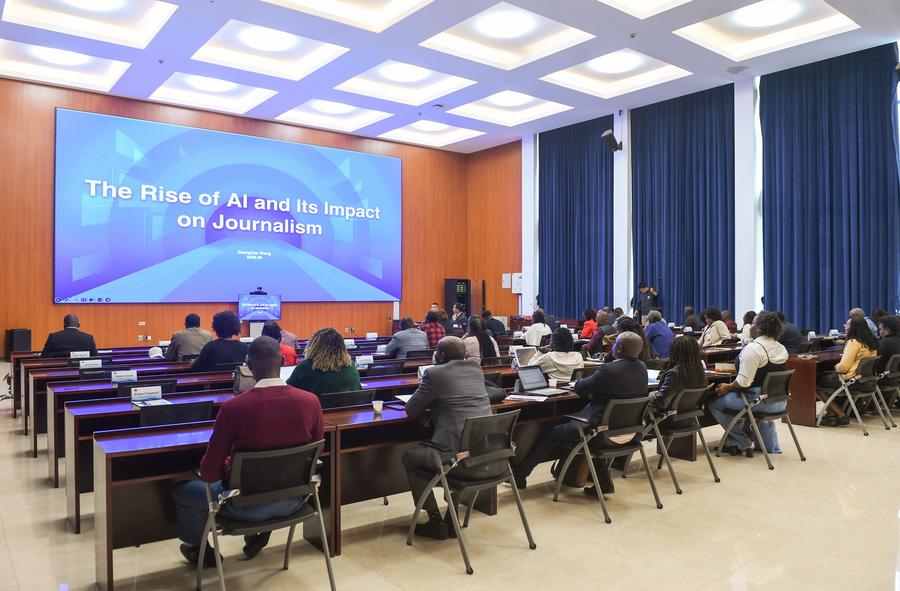

NAIROBI, Kenya, Media professionals from across Africa gathered in Nairobi for a specialized training session on Artificial Intelligence (AI), an initiative aimed at strengthening journalists’ capacity to adapt to rapidly changing digital technologies and newsroom practices.
The training, organized by Xinhua News Agency Africa Regional Bureau, brought together nearly 200 journalists, editors, producers, and media practitioners from various African countries, both physically and virtually. Participants explored the growing role of AI in journalism, including its applications in news reporting, content production, visual storytelling, audience engagement, and fact-checking.
As media organizations worldwide embrace digital transformation, the seminar provided a platform for participants to exchange ideas, learn from experts, and discuss how emerging technologies can support innovation in modern newsrooms.
Speaking during the event, Zhang Zhizhong, Minister Counselor at the Chinese Embassy in Kenya, emphasized that artificial intelligence and other emerging technologies are reshaping the global media landscape. He noted that technological advancements are changing the way journalists gather, process, and distribute information, while creating new opportunities for innovation and audience engagement.
According to Zhang, the training served as an important forum for media professionals to share experiences, exchange knowledge, and explore practical approaches to integrating AI into journalistic work. He said such initiatives can help media organizations embrace innovation while maintaining professional standards and adapting to the evolving needs of audiences.
Participants received practical guidance on the use of AI-powered tools for news production and storytelling. Sessions focused on how technology can support journalists in research, data analysis, content development, and verification processes, enabling them to work more effectively in increasingly competitive media environments.
Samuel Maina, Editor-in-Chief of the Kenya Broadcasting Corporation (KBC), welcomed the training, describing it as a valuable opportunity for media practitioners to acquire new knowledge and skills. He noted that AI has the potential to enhance newsroom efficiency and improve content production without compromising journalistic integrity.
Maina said the lessons learned during the training would not only benefit individual participants but could also be shared with colleagues across various news organizations. He added that Kenya’s growing digital infrastructure and widespread internet access place the country’s media industry in a strong position to embrace AI-driven innovation on a larger scale.
For many participants, the training offered fresh perspectives on how technology can be used responsibly to improve journalistic practices. Journalists attending the event expressed optimism that AI can help streamline workflows, support fact-checking efforts, and enhance storytelling while preserving the core values of accuracy, fairness, and credibility.
The seminar also highlighted the importance of continuous professional development as technological change accelerates across the media sector. Experts encouraged journalists to view AI as a tool that complements human creativity and editorial judgment rather than replacing them.
The Nairobi training reflects growing collaboration between African and Chinese media institutions in promoting knowledge exchange, technological innovation, and capacity building within the journalism profession. Such partnerships are expected to contribute to a more digitally empowered media industry capable of meeting the information needs of diverse audiences.
As artificial intelligence continues to influence the future of communication and information sharing, participants agreed that equipping journalists with digital skills and technological literacy will be essential for ensuring that media organizations remain relevant, resilient, and effective in the years ahead.