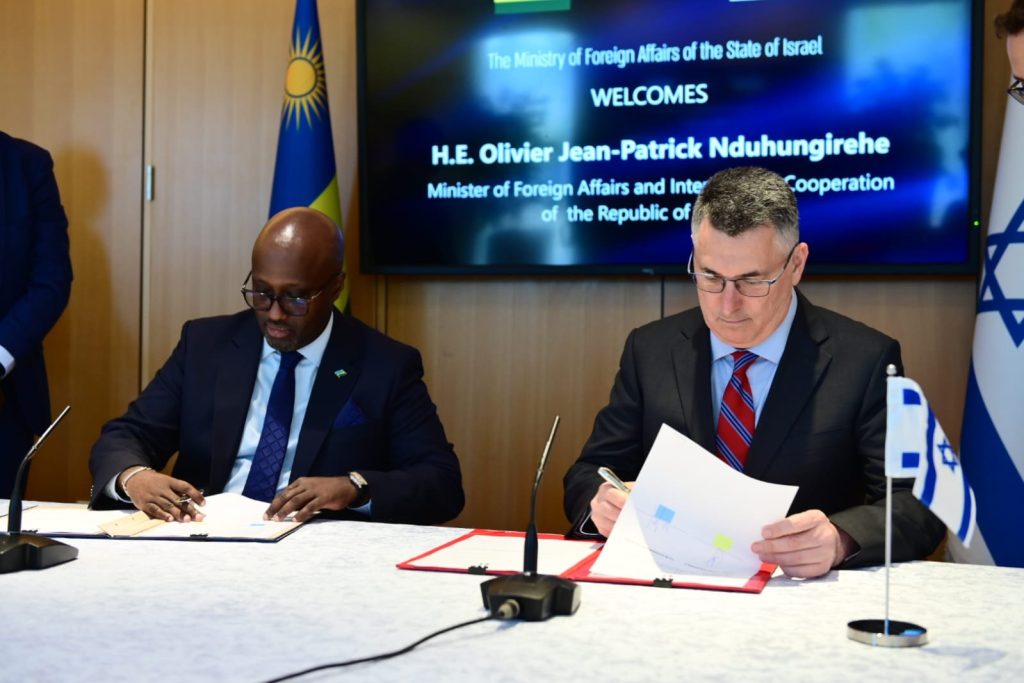
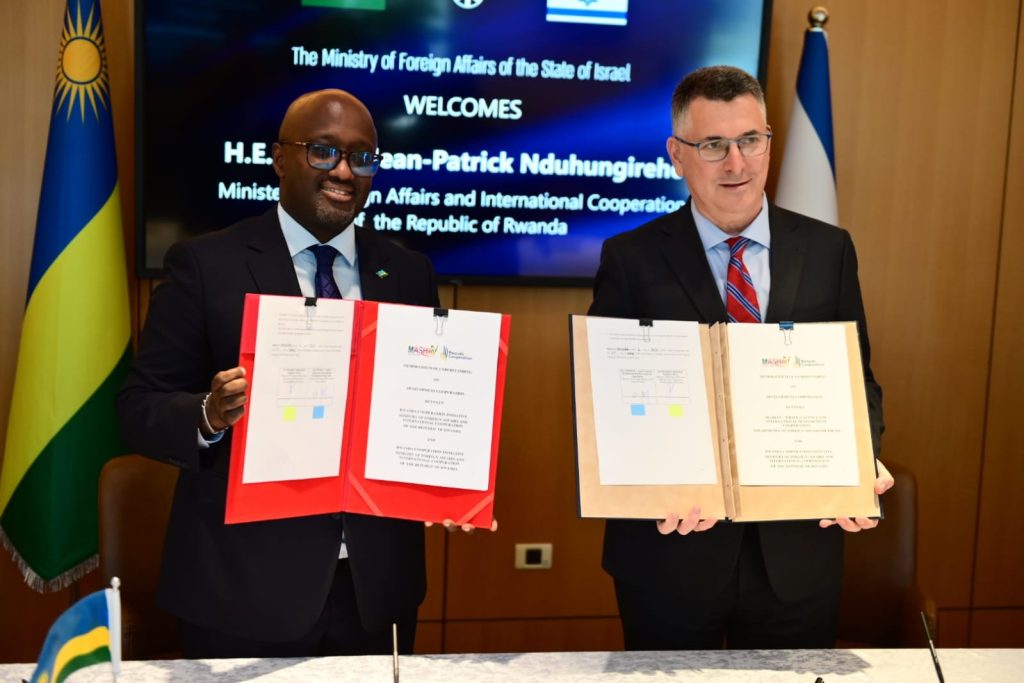

Rwanda and Israel have signed a series of cooperation agreements aimed at strengthening collaboration in basic education, digital learning and technology, higher education, and science-based research, as the two countries reaffirmed their growing bilateral partnership.
Rwanda’s International Cooperation Agency (RCI) and Israel’s Agency for International Development Cooperation, MASHAV, also signed a separate cooperation agreement to deepen collaboration on development initiatives.
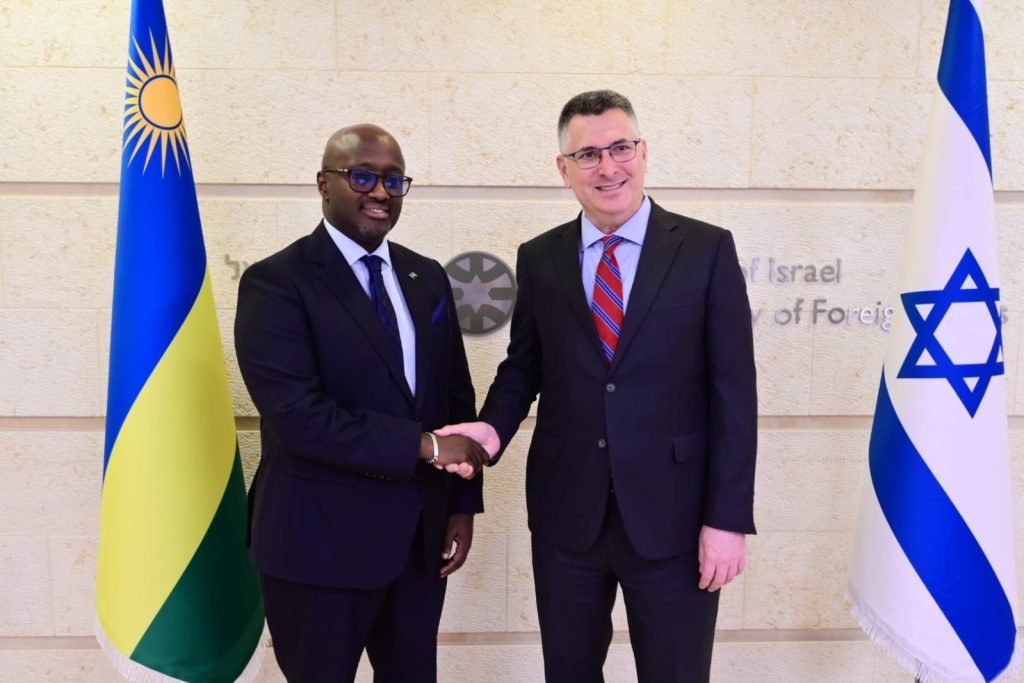
Welcoming Minister Nduhungirehe to Jerusalem, Sa’ar described the visit as a reflection of the strong friendship between the two nations, referring to Jerusalem as Israel’s “eternal capital.”
“Minister, Israel and Rwanda are two small nations with difficult histories but tremendous hope for the future. Both our peoples have experienced unimaginable tragedies. The Jewish people endured the Holocaust, while Rwanda suffered the Genocide against the Tutsi.”
Sa’ar said that despite their painful histories, both countries had refused to let the past determine their future, instead choosing national reconstruction and development.
“Our countries chose to rebuild rather than be defined by tragedy. Those shared experiences have created a unique friendship between us, and I am pleased that we are expanding knowledge exchange in the field of education.”
The Israeli foreign minister also noted that although Rwanda and Israel are geographically small, they have demonstrated that a country’s strength lies in the determination and resilience of its people.
“Israel and Rwanda prove that a nation’s greatness is not measured by its size, but by the determination and resilience of its people. Rwanda has become one of Africa’s fastest-growing economies, driven by innovation and development.”
Sa’ar added that despite decades of security challenges, Israel has developed into a global hub for technology, scientific research, and investment.
“We believe that a country’s greatest resource is its people. Looking at the agreements signed today, it is clear that our partnership is delivering real and meaningful results.”
Minister Nduhungirehe said the relationship between Rwanda and Israel goes beyond diplomacy, emphasizing the historical experiences that have shaped both nations.
“Rwanda and Israel share a relationship that extends beyond diplomatic ties. Both countries have endured profound tragedies, but what defines us today is the resilience of our people and our determination to transform suffering into development—from the aftermath of genocide to economic growth, innovation, and a new chapter for our citizens.”
He explained that the agreements signed by the two countries’ international cooperation agencies would promote the exchange of expertise in solving development challenges, while the education partnership would strengthen knowledge sharing, professional training, academic exchanges, and institutional capacity building.
“Today’s discussions and agreements demonstrate the strength of our partnership and our shared commitment to expanding cooperation for the mutual benefit of our two countries. I am confident that this visit will further deepen the relationship between Rwanda and Israel.”
During the visit, Minister Nduhungirehe and the Rwandan delegation toured several sites in Jerusalem, including the Western Wall, also known as the Kotel, and Yad Vashem, Israel’s national memorial dedicated to the victims of the Holocaust.
The newly signed agreements are expected to expand cooperation in education, innovation, scientific research, and human capacity development, further strengthening the longstanding ties between Rwanda and Israel.