

On July 8, 2026, the U.S. Central Command (CENTCOM) announced that it had carried out a major airstrike on Iranian military positions in the country’s south.
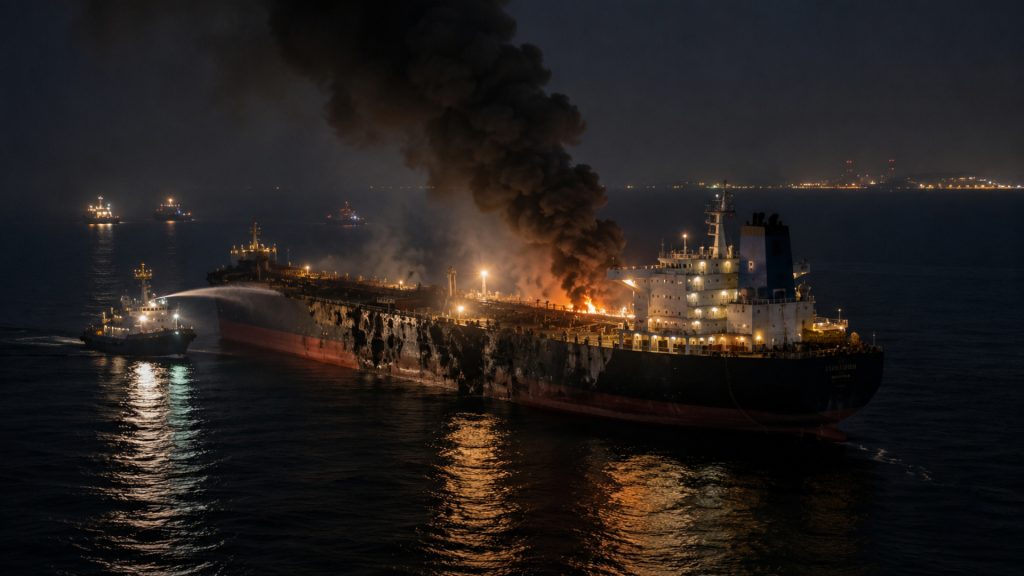
Washington said the attack was a direct response to Iranian strikes on July 7 targeting three commercial vessels transiting the Strait of Hormuz.
In retaliation, Iran’s Islamic Revolutionary Guard Corps (IRGC) announced that its naval and aerospace forces had launched attacks on 85 key U.S. military installations in Bahrain and Kuwait.
Both sides have described their actions as retaliatory measures, with the latest escalation stemming from a dispute over the management and security of maritime traffic in the Persian Gulf.
On June 24, the Government of Oman and the International Maritime Organization (IMO) announced a temporary shipping corridor along Oman’s coast, protected by the United States, to allow stranded vessels to resume navigation.
Iran immediately condemned the move, arguing that it had been implemented without consultation with regional countries. Tehran warned that any vessel wishing to use the corridor would first require authorization from Iranian authorities.
Following the warning, two vessels reportedly used the route without Iran’s approval. The IRGC attacked the ships, prompting the IMO to suspend all rescue operations in the area.
During the night of June 26–27, the United States launched strikes against Iranian military positions in southern Iran in response to the attacks on the vessels. Iran retaliated by striking U.S. military bases in Bahrain and Kuwait.
On June 28, the two countries agreed to halt hostilities and resume negotiations aimed at reaching a permanent peace agreement.
However, on July 7, Iranian forces again attacked three commercial ships passing through the Strait of Hormuz, prompting another round of U.S. airstrikes against Iranian military positions.
CENTCOM said its latest operation was intended to impose “significant costs” on Iran for attacking commercial vessels carrying “innocent civilians in international waters.”
The U.S. military accused Iran of engaging in provocative actions that undermine the ceasefire agreement reached while both sides were preparing for broader peace negotiations.
The IRGC, meanwhile, said its attacks on U.S. military installations were retaliation for what it described as Washington’s violation of the ceasefire and preliminary agreements that had been facilitated largely through Pakistan.
Iran also accused the United States of deliberately launching the strikes while the country was preparing for the funeral of former Supreme Leader Ayatollah Ali Khamenei, alleging that Washington intended to disrupt the national event.
Tehran maintains that the preliminary agreement reached last month grants Iran the authority and responsibility to oversee and protect all maritime traffic passing through the Strait of Hormuz.
The United States rejects that interpretation, arguing that the agreement requires Iran to ensure the free, secure, and unrestricted passage of all commercial vessels through the strategic waterway.
As international organizations express growing concern over the safety of civilian shipping in the region, analysts warn that unless tensions are quickly defused, the latest exchanges could trigger another prolonged military conflict in the Middle East.