

Asian stock markets tumbled sharply on Wednesday, led by a dramatic selloff in South Korea, as investors reacted to escalating Middle East tensions and rising oil prices that threaten to fuel inflation and delay global interest rate cuts.
Seoul Triggers Circuit Breaker
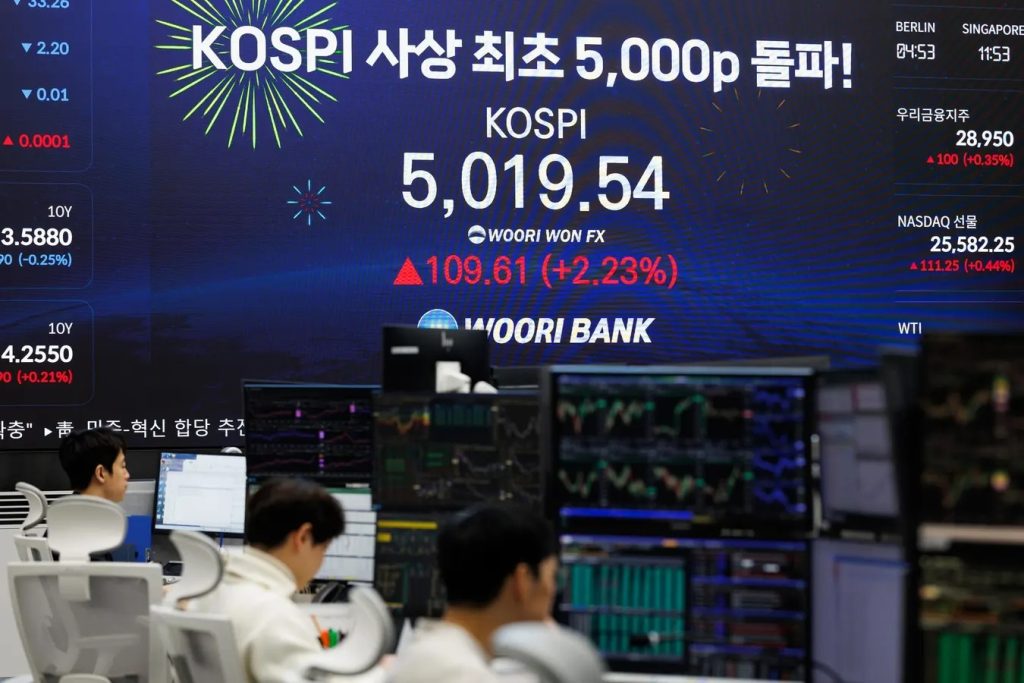
South Korea’s KOSPI index plunged more than 11% at one point, forcing trading to halt under an automatic circuit breaker mechanism. The benchmark is now down 17% over two days, its heaviest selloff since 2009.
The Korean won also slid to a 17-year low, reflecting deep investor anxiety as global funds rushed to exit riskier positions.
Chip Stocks Lead Regional Rout
The sharp declines spread across Asia’s major markets, particularly in semiconductor-heavy exchanges. Japan’s Nikkei 225 dropped 4.3%, while Taiwan’s main index fell 3.6% as traders dumped shares in chipmakers, one of the strongest-performing sectors in recent months.
Futures in the United States and Europe also slipped, with S&P 500 futures easing 0.6% as global investors reassessed risk exposure, as reported by Reuters.
Oil Surge Fuels Inflation Concerns
Brent crude oil climbed above $82 per barrel, up more than 13% for the week, driven by fears that the widening conflict involving the United States, Israel, and Iran could disrupt energy supplies.
Strikes on Iranian assets and reported attacks on Gulf oil infrastructure have heightened concerns about prolonged instability. Although US President Donald Trump announced measures to guarantee shipping insurance and possible naval escorts through the Strait of Hormuz, markets remain uneasy.
European gas prices have surged nearly 65% in just two days, intensifying fears of renewed inflationary pressure.
Investors Brace for Longer Conflict
Market strategists say the key concern now is whether elevated energy prices will persist long enough to derail expectations of interest rate cuts.
Japan, South Korea, and Taiwan, all major energy importers, are especially vulnerable to oil price shocks. Their markets, which had rallied strongly in recent months, are now facing heavy profit-taking as global investors seek safer assets.
Gold, another strong performer this year, fell 4.5% overnight as traders liquidated positions to cover losses elsewhere, while the Australian dollar slipped below 70 US cents.
Inflation and Rate Cut Uncertainty
On Wall Street, the S&P 500 closed 0.8% lower amid fears that prolonged higher oil prices could reignite inflation just as central banks were preparing to ease monetary policy.
Analysts say the central question now is whether energy costs will remain elevated long enough to delay expected interest rate reductions, a scenario that could extend market volatility in the weeks ahead.
With geopolitical tensions deepening and energy infrastructure increasingly under threat, investors worldwide are bracing for prolonged instability that could reshape both inflation forecasts and global monetary policy expectations.