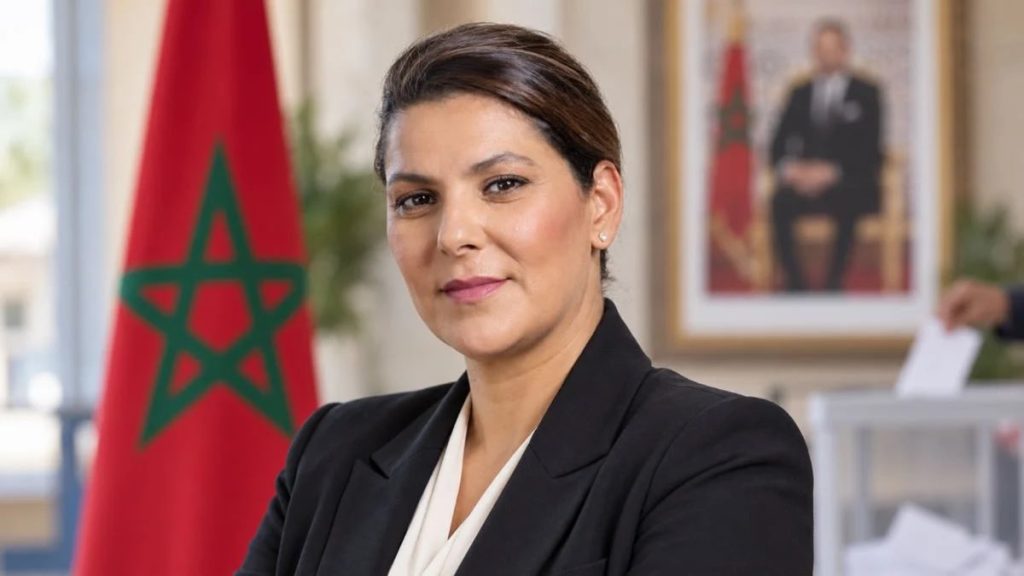

El Mansouri was appointed by King Mohammed VI, who chose her over Fouzi Lekjaa, the president of the Moroccan Football Federation and another prominent PAM politician.
The 50-year-old politician has served as Mayor of Marrakesh on two occasions and was also a minister in the outgoing coalition government.
She becomes the second woman to head a government in an Arab country, after Najla Bouden, who served as Prime Minister of Tunisia.
Morocco is a constitutional monarchy, although significant powers remain in the hands of the King.
At a press conference following her party’s electoral victory, before her appointment as Prime Minister, El Mansouri was asked whether the government would need to make changes to allow her to attend Islamic religious ceremonies alongside the King.
These ceremonies include Friday prayers and Eid celebrations, where men and women traditionally pray in separate areas.
El Mansouri did not directly answer the question. Instead, she praised King Mohammed VI, describing him as the leading advocate for women’s interests in Morocco.
El Mansouri is one of the most prominent women in Moroccan politics. She studied law at Mohammed V University in Rabat before continuing her education in France and the United States, where she specialized in business and corporate law.
She entered politics following the establishment of PAM in 2008. In 2009, she became the first woman to lead the city of Marrakesh and returned to the position following the 2021 elections.
For the past five years, she served as Minister of National Territorial Planning, Urban Planning, Housing and City Policy in the government led by Aziz Akhannouch.
In February 2024, she became coordinator of PAM’s leadership, after the party adopted a collective leadership structure instead of having a single Secretary-General.
Morocco’s Constitution provides that the King appoints the head of government from the party that wins the largest number of seats in the House of Representatives.
Following the announcement of the election results, El Mansouri said the decision to choose between her and Lekjaa was in the hands of the King.
In previous elections, it was easier to determine who would become Prime Minister because political parties were generally led by a single Secretary-General.
PAM won 97 seats, but this was not enough to secure an outright majority in the 395-member Parliament. The party will need to form a coalition with other parties to reach the minimum of 198 seats required for a majority.
It is not yet clear which parties PAM will work with, particularly as it has had disagreements with the National Rally of Independents (RNI), which led the outgoing government and included PAM as a coalition partner.
The Islamist Justice and Development Party (PJD) won 54 seats, up from the 13 seats it secured in the previous election.
The PJD’s renewed strength was partly attributed to the return of Abdelilah Benkirane as its leader. Benkirane also previously served as Prime Minister.
Following the election, Benkirane said the PJD would remain in opposition and ruled out cooperation with PAM.