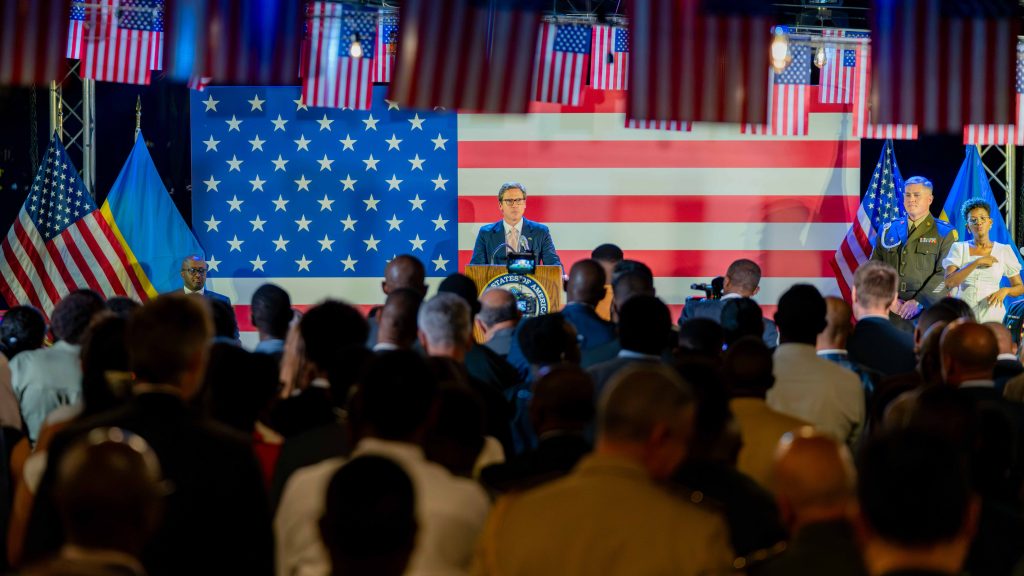


Speaking on June 4, 2026, during celebrations marking the 250th anniversary of U.S. independence, Nduhungirehe praised the strong partnership between Rwanda and the United States and highlighted growing collaboration in science, technology, innovation, and space exploration.
Rwanda is among the 67 countries that have signed the Artemis Accords, a set of principles established by the United States and NASA in 2020 to guide peaceful and sustainable exploration of outer space, including future missions to the Moon.
The minister said Rwanda is actively exploring practical ways to work with NASA and other Artemis partner nations in areas such as scientific research, capacity building, innovation, and economic development.
“As a signatory to the Artemis Accords, Rwanda is committed to identifying concrete opportunities for collaboration with NASA and hopes to develop joint projects that will contribute to research, skills development, and economic growth,” Nduhungirehe said.
He explained that Rwanda joined the Artemis Accords to help ensure that outer space, the Moon, and other celestial bodies are explored responsibly and preserved for future generations. Membership also gives Rwanda a seat at international discussions shaping the future of space governance and exploration.
Broader Rwanda–U.S. Cooperation

Beyond space exploration, Nduhungirehe highlighted progress in bilateral relations through the Strategic Bilateral Dialogue framework, which covers health, trade, education, technology, investment, and innovation.
He noted that Rwanda and the United States are expanding cooperation in sectors expected to shape the future, including critical minerals, advanced technologies, and the peaceful use of nuclear energy.
The minister welcomed a recent nuclear cooperation agreement signed during the Nuclear Energy Innovation Summit for Africa held in Kigali. The agreement includes support for Rwandan students studying nuclear sciences in the United States, funding opportunities for nuclear-related projects, and broader technical cooperation.
Nduhungirehe also pointed to growing American investment in Rwanda, including partnerships involving Trinity Metals and U.S. firms importing Rwanda’s wolfram (tungsten) minerals.
He further praised the contribution of Zipline, whose drone technology has strengthened healthcare logistics and medical supply delivery in Rwanda. Rwanda recently became the first country to sign an agreement expanding Zipline’s operations following a $150 million U.S. investment in the company.
Recognition of the Genocide Against the Tutsi

Nduhungirehe also described 2026 as a significant year in Rwanda–U.S. relations because, for the first time, the United States officially used the term “Genocide Against the Tutsi” in its commemorative messages during Kwibuka.
He said the move represents respect for historical truth and honors both the victims and survivors of the genocide.
“Using the correct terminology is a way of respecting historical truth, honoring the victims and survivors, and strengthening efforts to combat genocide denial and distortion around the world,” he said.
Support for Regional Peace
The minister also thanked the United States for its efforts to promote peace and security in the Great Lakes region, particularly its role in diplomatic initiatives aimed at ending the conflict in eastern Democratic Republic of the Congo.
He expressed hope that ongoing mediation efforts would address the root causes of the conflict and contribute to lasting peace, regional stability, and expanded opportunities for trade and investment.
Source: IGIHE