
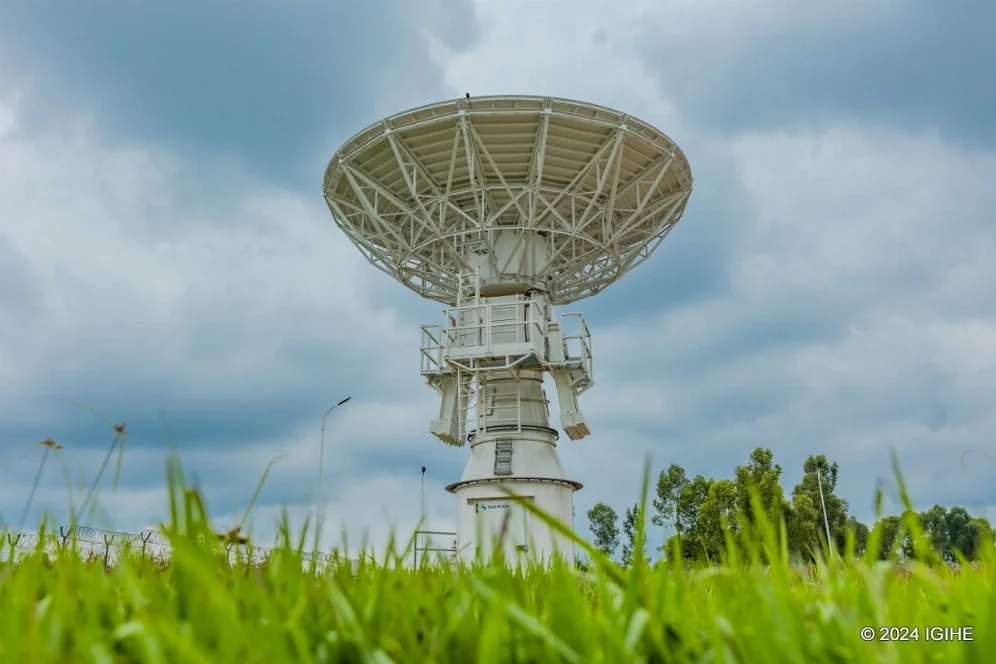

A teleport is a facility equipped with antennas that receive data transmitted by satellites. In other words, operators of satellites in space need ground-based infrastructure where the data they transmit can be received. Rwanda’s teleport is located in Mwurire Sector, Rwamagana District.
The new antenna will be operated by U.S.-based York Space Systems, a company that develops small satellites and the systems used to control them and exchange data, in partnership with ATLAS Space Operations, a company specializing in space communications.
The two companies announced that the new antenna became operational on September 18, 2026.
The addition of the antenna means the number of satellites that Rwanda’s teleport can communicate with simultaneously has effectively doubled, while also increasing its ability to communicate with satellites operating in orbits close to the Earth’s equator.
Rwanda’s RSA-operated teleport has been awarded a Tier 3 certification, recognizing it as one of the leading satellite communications infrastructure facilities in sub-Saharan Africa.
The certification was issued by the World Teleport Association (WTA), an organization that monitors teleport operators and companies managing satellite communications infrastructure around the world.
Rwanda received the certification on June 3, 2026. Its teleport is the only facility in sub-Saharan Africa to have received the highest-level certification and is ranked second on the African continent after a teleport in Egypt.
It also made history as the first government-operated teleport in the world to receive the certification.
The certification further means Rwanda’s teleport is considered highly reliable infrastructure capable of providing communications services around the clock.
Only a limited number of teleports have received this certification, including Egypt’s Nilesat, which is considered one of Africa’s more advanced facilities in this field, while Cameroon has a provisional certification.
Given its capabilities, the teleport’s growing demand helps explain why it has received a second antenna only a short time after the first began operations.
The first antenna at the teleport became operational in July 2025 under an agreement with ATLAS Space Operations. The second antenna was also installed through the same partnership.
Teleports are normally built in open areas free of mountains, trees or other obstacles that could interfere with the antennas used to receive satellite data. In Rwanda, studies identified Rwamagana as a suitable location based on the technical requirements.
The teleport is located at approximately two degrees south of the Earth’s equator, at an altitude of 1,668 metres.
This location allows its antennas to access satellites operating in low-inclination orbits close to the equator that ground stations located farther from the equator may not be able to see.
The location also provides greater opportunities to communicate with satellites operating in mid-inclination orbits.
With two operational antennas, Rwanda can now communicate and exchange data with two satellites simultaneously. This increases the teleport’s capacity for existing operations while also enabling it to serve new clients whose satellites operate in orbits close to the equator.
The new antenna was completed in early 2026, shipped to Rwanda in May, installed at the teleport in August and became operational in September 2026.
During testing before its official commissioning, the antenna successfully completed more than 350 scheduled communication sessions with a 100 percent success rate, without errors or technical failures.
The new antenna has a diameter of 3.7 metres and is a receive-only parabolic reflector. It is mounted on a dual-axis azimuth/elevation pedestal, allowing it to point horizontally and vertically, as well as to the left and right.
It can receive data transmitted to Earth through S-band downlinks operating between 2,200 and 2,300 megahertz, with both left- and right-hand circular polarization.
This capability allows the antenna to maintain reliable and uninterrupted data reception regardless of the satellite’s orientation as it moves through space.