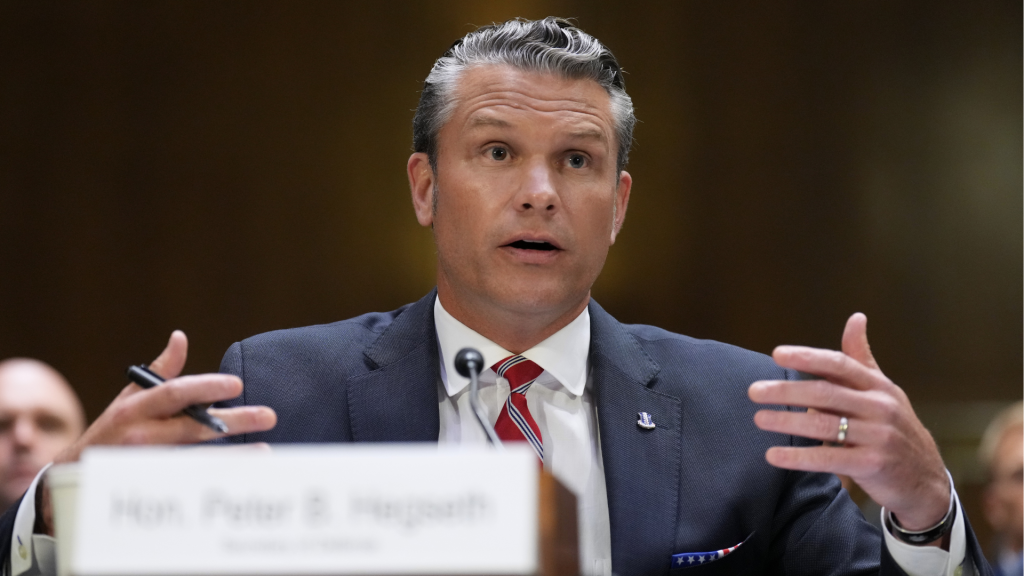

Appearing before the U.S. Senate Appropriations Committee, Hegseth urged lawmakers to approve an additional $87 billion for the Department of Defense, with $67 billion earmarked for military operations in the Middle East.
It was Hegseth’s first appearance before Congress since fighting between the United States and Iran escalated again last week following the confirmed deaths of three American service members blamed on Iran.
The White House had already requested in April that Congress approve a $1.5 trillion defense budget for the next fiscal year—the largest military budget request in U.S. history.
His testimony came as the United States continued its military campaign against Iran, with Tuesday marking the 11th consecutive day of strikes. Iran has continued retaliatory attacks against U.S. forces and allied countries across the Middle East.
Describing the gravity of the situation, Hegseth told senators:
“We are living in a dangerous world,” stressing that the current security environment requires swift and decisive action.
Responding to criticism over the size of the funding request, he argued that the additional military spending is urgently needed.
“Without these funds, we could face serious challenges that would undermine our ability to pay our troops, rapidly replenish weapons and ammunition, and sustain critical military operations without disruption,” Hegseth said.
The Chair of the Senate Appropriations Committee, Senator Susan Collins, asked the Defense Secretary about the consequences if Congress failed to approve the requested funding.
Hegseth warned that current and planned military training exercises could be canceled due to funding shortages. He also accused former President Joe Biden’s administration of neglecting the military by failing to allocate sufficient defense funding.
When Democratic Senator Dick Durbin asked for an estimate of how much the conflict with Iran had cost so far, Hegseth said the figure stood at $37.5 billion.
Democratic Senator Patty Murray criticized the funding request, calling it difficult to justify, although defense analysts have suggested the estimated cost of the conflict may actually be higher.
The proposal has faced opposition from Democrats, while some Republicans have also expressed reservations.
While Hegseth was testifying before the Senate, President Donald Trump posted on his social media platform, Truth Social, a list of America’s longest and deadliest wars, detailing their duration and the number of American casualties.
Trump said that 18 American service members have been killed since the conflict with Iran began on February 28.
On Tuesday, the Pentagon announced the death of Sgt. Michael Emmanuel Swinton, a 30-year-old U.S. soldier killed in Iraq. It also said that Sgt. Angel Rampersad, 28, is believed to have died in Jordan.
On Monday, the U.S. military had already released the names of two other service members killed in fighting in Jordan: 19-year-old Isabella Gonzales and 25-year-old Tyler Feehan.
President Trump is expected to travel to Dover Air Force Base in Delaware on Wednesday to honor the fallen troops as their remains are returned to the United States.