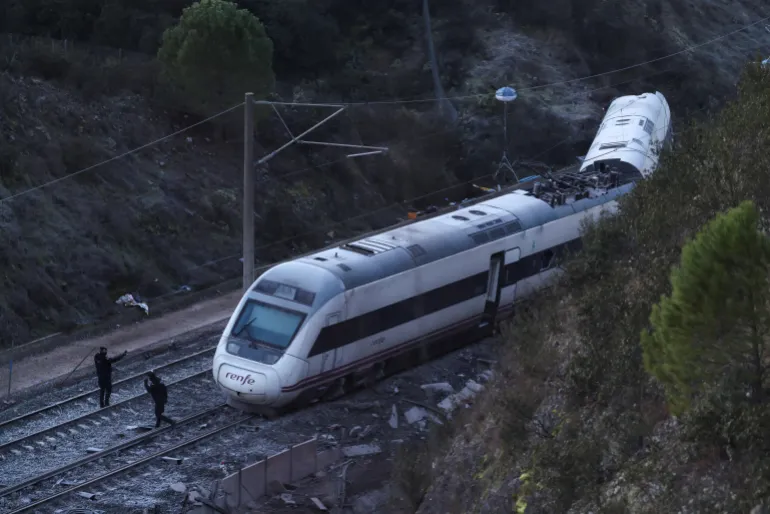

At least 39 people were killed and more than 150 injured after two high-speed trains collided and derailed in southern Spain on Sunday evening, in what officials described as the country’s worst rail disaster in more than a decade.
The crash occurred at around 7:45 p.m. local time near the town of Adamuz in the province of Córdoba, when the rear of a train travelling from Málaga to Madrid derailed and slammed into the front of another train heading from Madrid to Huelva. Around 400 passengers were on board the two trains, operated by private company Iryo and state-owned Renfe.
Rescue teams worked through the night in difficult conditions, pulling survivors from twisted carriages and treating the wounded at makeshift medical centres. Spain’s Civil Guard said more than 220 personnel were deployed in the operation, while forensic teams began the painstaking task of identifying victims. Authorities have warned that the death toll may rise as some passengers remain unaccounted for.
Transport Minister Óscar Puente said the cause of the crash remains unknown and described the incident as “truly strange,” noting that it occurred on a flat, recently renovated section of track and involved a train less than four years old. An official investigation is under way and could take up to a month, he said.
Survivors recounted scenes of terror. “Everything went dark, people were thrown around, luggage was flying,” said one passenger, while another described the aftermath as “like a horror movie,” with shattered glass, injured travellers and cries for help echoing through the wreckage.
The tragedy has prompted an outpouring of sympathy at home and abroad. King Felipe VI and Queen Letizia expressed their “deepest condolences” to the families of the victims, while Prime Minister Pedro Sánchez said the nation was in “deep pain” and cancelled his planned trip to the World Economic Forum in Davos. Messages of support also came from European leaders, including French President Emmanuel Macron and European Commission President Ursula von der Leyen.
Spain’s Congress of Deputies observed a minute of silence, and several cities, including Huelva, declared days of mourning. More than 130 train services across Andalusia and key routes from Madrid were cancelled as safety checks and recovery operations continued.
Spain operates the largest high-speed rail network in Europe and one of the biggest in the world, a system used daily by millions and widely regarded as safe. The crash has nonetheless revived painful memories of past rail tragedies, including the 2013 derailment in Galicia that killed 80 people.
As investigators work to determine what caused the collision, the country remains in mourning, united in grief for the victims and in solidarity with their families, while hoping that answers will soon emerge to prevent such a disaster from happening again.