
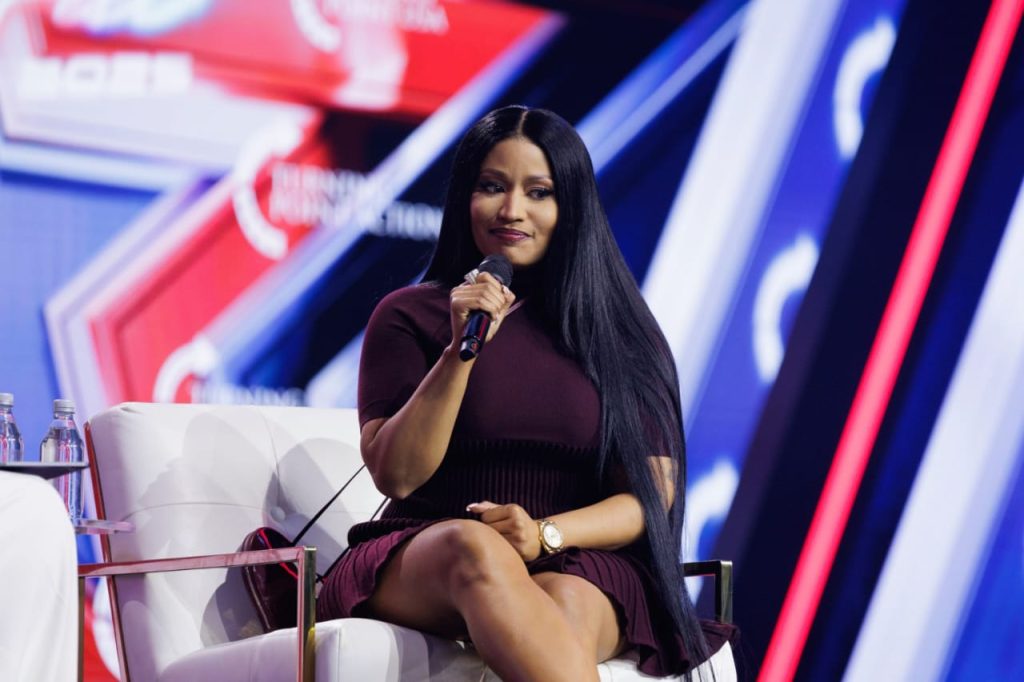

Rap superstar pledges $150K–$300K to fund children’s savings program, sparking debate among fans and political commentators.
RAP AND POP CULTURE MEET U.S. POLITICS in an unexpected way this week as rap superstar Nicki Minaj publicly pledged significant financial support for a new economic initiative backed by President Donald Trump’s administration, known as “Trump Accounts.” The announcement, made ahead of a high‑profile summit in Washington, D.C., marks one of the most visible instances yet of Minaj’s overt engagement with Trump‑era policy efforts and it comes amid rising debate about her role in American politics and her relationship with the former president.
According to reports, Minaj has said she’ll contribute between $150,000 and $300,000 to help fund “baby Trump Accounts” , small, tax‑deferred investment accounts designed for children born between January 1, 2025 and December 31, 2028. These accounts, part of the Trump administration’s broader “One Big Beautiful Bill,” automatically give eligible children a $1,000 starter deposit from the U.S. Treasury as a seed investment for long‑term savings. Parents and employers can add more over the years until age 18.
Minaj’s contribution is intended to specifically help “Barbz babies” a reference to her fanbase, known as the Barbz secure early financial footing and learn about investment and money management. Her decision comes from personal experience, she says, recalling financial struggles during her upbringing in Queens and Trinidad.
She is expected to make the pledge public alongside Trump administration officials, including adviser Alex Bruesewitz, at a summit in Washington where the initiative will be promoted.
The “Trump Accounts” program was codified into law as part of the One Big Beautiful Bill, signed last year. It aims to inject early savings into the accounts of millions of American children. In addition to the federal seed funding:
Parents can contribute up to $5,000 per year per child.
Employers can add up to $2,500 per year.
Fund access is limited until the account holder turns 18.
Treasury Secretary Scott Bessent has said that more than 500,000 accounts have already been opened in recent days, and additional private‑sector contributions are expected. Billionaire philanthropists like Michael and Susan Dell, along with major corporations including BlackRock, Visa, Mastercard, and Uber, have pledged tens of billions toward similar supporting efforts.
This financial pledge is the latest step in what has become a more public and visible political alignment between Nicki Minaj and elements of the Trump administration and conservative policy spheres.
In December 2025, she made headlines for her appearance at Turning Point USA’s AmericaFest conference in Arizona, where she praised President Trump and Vice President J.D. Vance, calling them role models and saying she had “the utmost respect” for Trump’s leadership, remarks that drew both broad attention and fierce backlash from some fans.
That event marked a notable shift for Minaj, who has long been a larger‑than‑life figure celebrated across pop and hip‑hop culture but not typically aligned with mainstream Republican politics. Her comments about Trump and his inner circle have sparked intense reaction online, from admiration by some conservative commentators to sharp criticism from others, including parts of her own fanbase.
Earlier in her career, Minaj had expressed criticism of some Trump administration policies — notably on issues like immigration making her recent turn even more striking to observers.
Culture Clash: Fan Reactions and Backlash
Minaj’s political emergence has ignited passionate responses. Some fans have expressed pride and support for her newfound activism, while others have reacted with disappointment or outright opposition, viewing her alliance with Trump as a betrayal of her artistic legacy or personal values.
On social platforms, some users have even launched viral petitions calling for her deportation and criticizing her public statements highlighting how celebrity politics can sharply divide opinion in communities that once supported her for cultural, not political, reasons. (Those petitions have gained traction on sites like Change.org, though their accuracy and impact vary.)
For the Trump administration, securing high‑profile endorsements even in nontraditional forms like charitable pledges can attract attention to policy initiatives that might otherwise slip under the radar. A celebrity figure such as Minaj bringing her platform to a policy geared toward economic empowerment may help broaden awareness, especially among younger and more diverse audiences.
For Minaj, the pledge underscores a growing willingness to merge her public persona with political influence and advocacy, entering a space where few rap superstars have tread so boldly. Whether this deepens her engagement with conservative politics or remains a high‑visibility one‑off act tied to this specific initiative remains to be seen.