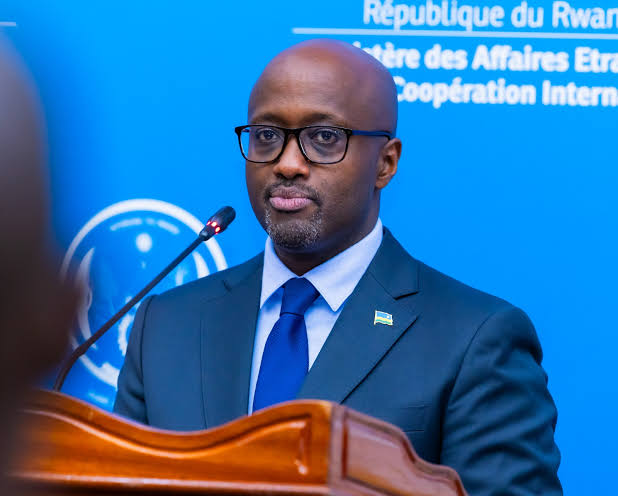

Rwanda’s Minister of Foreign Affairs and International Cooperation, Olivier Nduhungirehe, has rejected continued attempts to hold Rwanda responsible for the Democratic Republic of Congo’s (DR Congo) longstanding political and security challenges, insisting that sustainable peace requires Congolese-led solutions and genuine implementation of existing regional and international commitments.
Speaking to AFP in Moscow on the sidelines of the Russia-Africa Summit, Nduhungirehe challenged what Kigali considers a persistent tendency to attribute DR Congo’s internal instability to Rwanda.
“Rwanda must not be held as a scapegoat for what is happening in Congo forever,” he said.
His remarks come amid growing concerns over limited progress in implementing the Washington Accords between Rwanda and DR Congo, particularly regarding commitments to address the security threat posed by the Democratic Forces for the Liberation of Rwanda (FDLR).
Washington Accords face implementation challenges
Under the Washington framework, DR Congo committed to neutralising the FDLR, while Rwanda undertook to lift its defensive measures against the militia.
The FDLR is an armed group established by elements linked to the perpetrators of the 1994 Genocide against the Tutsi in Rwanda. Its continued presence in eastern DR Congo remains a central security concern for Kigali and a longstanding source of tension between the two neighbouring countries.
Rwanda maintains that Kinshasa has demonstrated insufficient political will to fulfil its commitments, pointing to continued cooperation between elements of the Congolese armed forces and the FDLR.
These concerns have also been reinforced by reports documenting the militia’s continued activities in eastern DR Congo.
A United Nations report released on September 21 indicated that the FDLR remained operational in several parts of eastern DR Congo, with reported killings and forced disappearances of civilians, particularly in Rutshuru territory, as well as Masisi, Nyiragongo and Walikale.
Other reports have raised concerns over continued support for the militia and its cooperation with Congolese government forces in military operations against the AFC/M23 rebel coalition.
For Kigali, addressing the FDLR threat remains an essential component of implementing the Washington Accords and creating conditions for sustainable regional security.
DR Congo’s political challenges require Congolese solutions
Beyond the security dimension, Nduhungirehe also rejected allegations by Kinshasa that former Congolese President Joseph Kabila was acting as a Rwandan proxy following his announcement as leader of the Front for the Refoundation of the Nation (FRN).
The political development has added another dimension to DR Congo’s already complex domestic landscape, where longstanding governance challenges, armed conflict and competing political interests continue to shape the country’s stability.
Nduhungirehe maintained that these developments should not automatically be attributed to Rwanda, arguing that responsibility for resolving the country’s internal political disputes rests primarily with Congolese actors.
“The situation in the DRC, the political situation, the security situation, is mainly a Congolese issue,” he said.
“It is a political issue that must be settled politically between the Congolese.”
His remarks underscore Rwanda’s position that regional diplomacy, while essential, cannot substitute for domestic political dialogue and accountability within DR Congo.
Renewed focus on accountability and regional peace
The latest statements come at a sensitive moment for diplomatic efforts aimed at de-escalating tensions between Kigali and Kinshasa.
Rwanda has previously raised concerns about the conduct of the United States-led mediation process, calling for an impartial approach that ensures commitments undertaken by both parties are implemented.
At the centre of Kigali’s position is the argument that lasting peace cannot be achieved without addressing the underlying security threats and political dynamics that have sustained instability in eastern DR Congo.
Nduhungirehe’s intervention in Moscow therefore reinforces two central messages from Rwanda: that the neutralisation of the FDLR remains indispensable to regional security, and that DR Congo’s internal political challenges ultimately require political solutions led by the Congolese themselves.
As diplomatic efforts continue, the implementation of existing commitments, particularly those under the Washington Accords, remains a critical test of whether negotiations can translate into tangible progress towards peace and stability in the Great Lakes region.