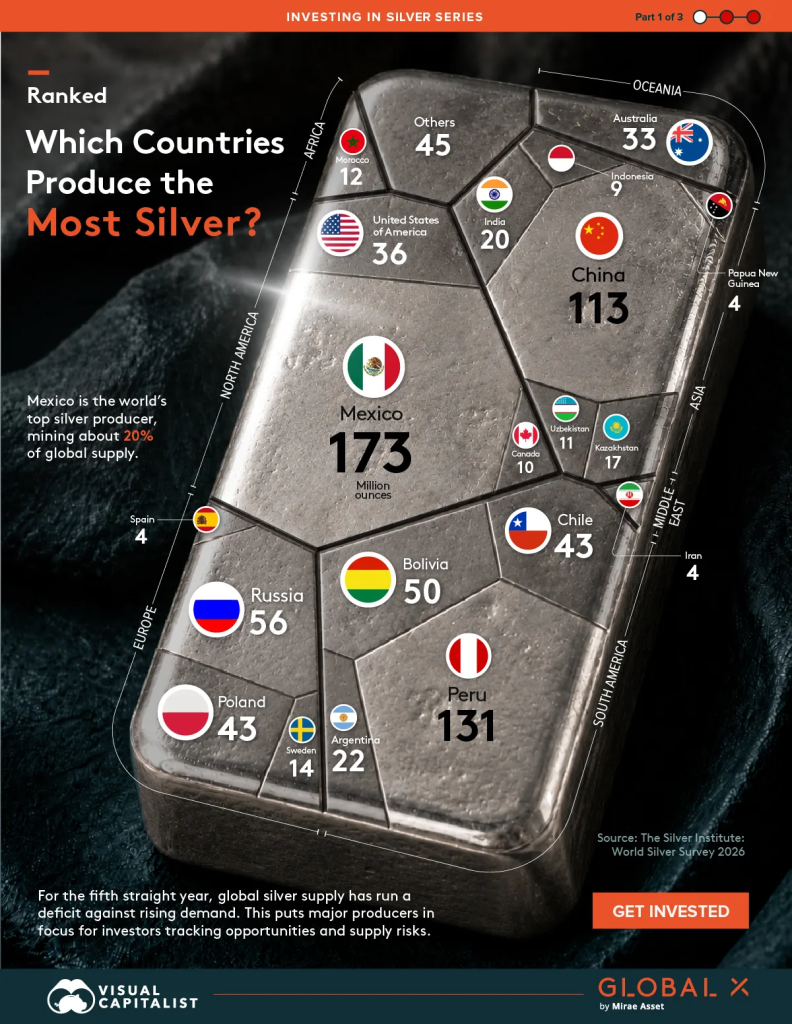

Morocco has secured a notable position among the world’s leading silver-producing countries, marking a significant achievement for its mining sector and reinforcing its growing influence in the global minerals industry. The country stands out as the only African nation included in a recent global ranking compiled by Visual Capitalist, underscoring its industrial progress and strategic importance in precious metal production.
According to the data, Morocco produces an estimated 12 million ounces of silver annually, equivalent to approximately 373 metric tonnes. This output places the country within a competitive group of global producers that continue to shape the dynamics of the international silver supply chain. While the figure remains modest compared to global leaders, it reflects steady production capacity and a mining sector that continues to expand in both scale and relevance.
The findings further emphasize Morocco’s dominant position within its region. The country accounts for around 95% of silver production in the Middle East and North Africa (MENA) region, making it the clear regional leader.
In addition, it accounts for approximately 86% of silver consumption in the same region, underscoring its rare dual role as both a major producer and a key consumer of the metal. This balance reflects a more developed and integrated mining and industrial structure compared to many neighboring economies, as BI Africa reports.
On the continental level, Morocco contributes nearly half of Africa’s total silver output, placing it firmly at the top of African silver-producing nations. This leadership position highlights the country’s long-term investment in mineral exploration, extraction infrastructure, and industrial capacity. It also reflects Morocco’s broader economic strategy of strengthening its natural resource sectors as part of national development priorities.
The global silver industry remains heavily concentrated among a few major producers. Mexico continues to lead worldwide production with approximately 173 million ounces annually, followed by Peru with 131 million ounces and China with 113 million ounces. These countries collectively form the backbone of global silver supply, driven by large-scale mining operations and well-established extractive industries.
The Visual Capitalist analysis further shows that North and South America dominate global output, jointly contributing the largest share of silver production worldwide. This concentration underscores the uneven distribution of mineral resources and highlights the strategic vulnerability of global supply chains that depend on a limited number of producing countries.
In recent years, the silver market has faced sustained pressure due to ongoing supply deficits. For five consecutive years, global demand has exceeded available supply, creating a structural imbalance in the market. This trend has been driven by increasing industrial demand, particularly from sectors such as electronics, solar energy, electric vehicles, and advanced manufacturing, all of which rely heavily on silver’s conductive and physical properties.
As global demand continues to rise, industry analysts suggest that countries with established production capacity and stable mining infrastructure are likely to play an increasingly important role in stabilizing supply. In this context, Morocco’s position becomes even more significant, as its consistent output and regional dominance provide a foundation for future growth and investment.
Beyond production figures, Morocco’s inclusion in the global ranking also signals broader opportunities for economic development. The mining sector is expected to benefit from continued investment in technology, exploration, and value-added processing industries. Such developments could enhance efficiency, increase export potential, and strengthen Morocco’s competitiveness in the global minerals market.
Experts also note that the country’s strategic geographic location, political stability, and growing industrial base further strengthen its attractiveness as a mining investment destination. These factors, combined with rising global demand for silver, place Morocco in a favorable position to expand its role in the years ahead.
Morocco’s position as Africa’s representative among top global silver producers reflects steady industrial growth, strong regional leadership, and deeper integration into global supply chains. With global demand for silver rising, the country is expected to gain even greater visibility and importance in the international mining sector.